
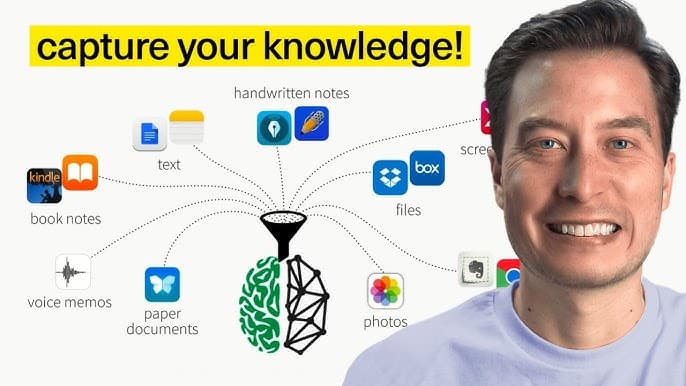
Reboot Your Second Brain: From Notes to Cognitive Extension
In the age of information overload, many knowledge workers turned to the idea of a “second brain” — a digital, externalized system for capturing notes, insights, resources, and memories. That approach offered relief from the limits of human memory, but it was still built on passive storage.
Today, artificial intelligence promises something deeper: a true cognitive extension. Not just a place to store what you knew, but a partner that helps you organize, internalize, reason, and learn.
Why the Old Model of Second Brain Was Limited
The classic “second brain” model — popularized by Tiago Forte and his methodology Building a Second Brain — rests on the principles of capturing, organizing, and retrieving knowledge. oai_citation:0‡Forte Labs
That model brought real benefits: a trusted external memory, less cognitive load, and easier ability to revisit ideas when needed. oai_citation:1‡Wikipedia
But many second-brain systems stopped there. They became digital filing cabinets: notes, tags, folders, backlinks — static repositories requiring manual effort to maintain. Retrieval depended on remembering how you stored things. Synthesis, internalization, and insight generation still fell on the human brain.
In other words: a second brain for storage — but not a second brain for thinking.
What Changes When AI Enters the Game
When you combine a second-brain archive with modern AI — large-language models, vector embeddings, semantic search, agents — the paradigm shifts. AI becomes a cognitive partner, not just a tool.
What AI adds
- Semantic ingestion & indexing — ingest notes, PDFs, docs, transcripts, media; make everything searchable by meaning, not just keywords. oai_citation:2‡Second Brain
- Synthesis & abstraction — automatically summarize, cluster, cross-link ideas, surface patterns and insights across disparate notes. oai_citation:3‡Medium
- Context-aware recall — ask natural-language questions: the AI finds relevant passages even if you forgot tags, keywords, or folder structure.
- Active learning assistance — use AI to quiz you, test recall, generate flashcards, simulate debates or hypothetical scenarios to help you internalize knowledge. (See recent study: AI tutor + spaced-retrieval significantly improved student learning outcomes.) oai_citation:4‡arXiv
- Dynamic memory + evolution — treat your archive as living knowledge: continuously updated, refined, validated, challenged. Not just static notes, but evolving internal memory.
In effect, AI turns your second brain from a passive vault into a living cognitive engine.
What a REAL AI-Powered Second Brain Looks Like
Here’s a proposed architecture for a next-gen second brain that uses AI — built for thinking, not just storage:
| Layer / Component | Role | Why It Matters |
|---|---|---|
| Capture Layer | Raw notes, articles, PDFs, transcripts, media, ideas | Ensures broad, friction-free intake of knowledge |
| Unified Ingestion & Indexing | Semantic embeddings, vector indexing, unified database | Makes retrieval robust, fast, and conceptually meaningful |
| Persistent Memory & Context | Agent memory of user’s background, projects, context | Allows cumulative understanding & personalized reasoning |
| Synthesis & Abstraction | Summaries, concept maps, clustering, cross-note linking | Turns raw data into usable knowledge, surfaces hidden connections |
| Active Learning Assistant | Flashcards, quizzes, Socratic prompts, simulated dialogues | Helps internalize knowledge, test understanding, build intuition |
| Interface Layer | Chat UI / natural-language interface, integrated in workflow | Lets you think with the second brain as naturally as thinking to yourself |
This architecture transforms the second brain from archive → partner.
The Risk of Treating AI as a Magic Mind
But — using AI doesn’t magically solve all problems. There are real risks:
- Garbage-in, garbage-out: if your notes are shallow or fragmented, AI can’t manufacture deep understanding. You still need good inputs.
- Over-automation & atrophy: over-relying on AI might stunt your own thinking, creativity, and intuition.
- Memory bloat & noise: with everything ingested, you may end with a huge, noisy database — risk of overload unless selectively curated.
- Context drift: knowledge stagnates if not periodically reviewed; AI suggestions may degrade over time without active human review.
- Privacy & trust: your second brain might contain sensitive personal or professional info — AI + security must be considered seriously.
Having a second brain — even AI-powered — requires discipline, governance, and active stewardship.
From Archive to Internalized Intelligence — The Learning Loop
To really benefit, treat the second brain as a learning partner, not just a vault:
- Capture everything with low friction — make “capture” a reflex, not a chore.
- Let AI digest, index, and synthesize — generate summaries, concept maps, insight clusters automatically.
- Use AI to test yourself — daily or weekly micro-quizzes, active recall, flashcards, Socratic exercises.
- Reflect & apply — turn insights into projects, experiments, writing, decisions.
- Iterate & prune — cull outdated notes, refine categories, evolve your “memory core.”
Over time, what began as external storage becomes internalized intelligence, and your human reasoning becomes augmented by a contextual, ever-learning partner — your real second brain.
What This Means for Modern Business & Learning
In a world of accelerating change — constant disruption, fast articles, shifting paradigms — the ability to:
- capture context fast
- internalize knowledge deeply
- connect ideas across domains
- adapt mental models rapidly
…will matter more than ever.
An AI-powered second brain is not a luxury:
It is a strategic asset.
For creators, leaders, strategists — this becomes a core competence.
For lifelong learners — this is how you stay afloat in info-dense eras.
For Reboot MBA — this is part of the “modern business acumen” we’re building:
not just knowledge, but thinking capacity + memory + adaptability.
Read more
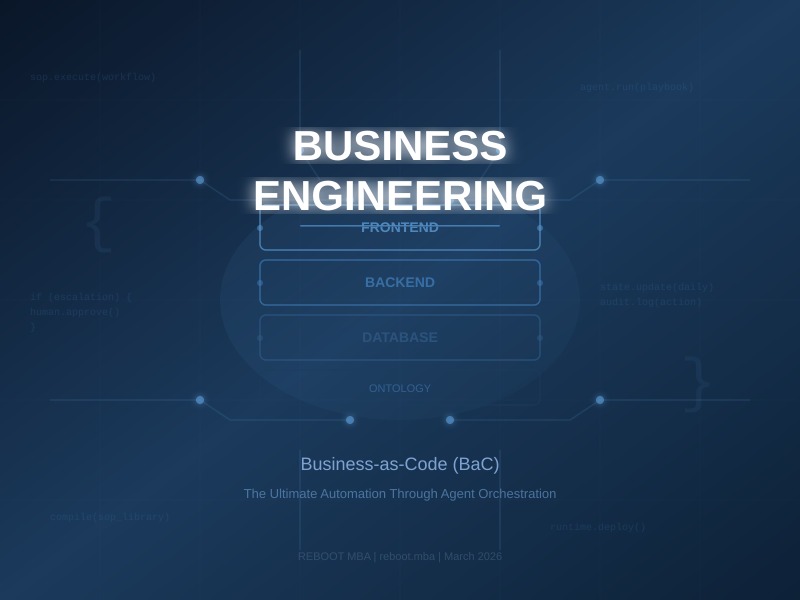
Business Engineering: Business-as-Code (BaC) — The Ultimate Automation Through Agent Orchestration
A research paper on the feasibility of AI-era Full-Stack Business Engineering. Every business is a codebase. SOPs are source code. AI agents are the runtime. This paper introduces Business Engineering as a formal discipline and Business-as-Code as its foundational methodology.

Rebooting Identity: The Economy of Data and Data Sovereignty in the Age of AI
Our identity infrastructure was never designed for a world of irreversible data leaks, platform extraction, and AI-driven impersonation. This essay outlines why identity must evolve into a sovereign, multi-layered, cryptographically anchored asset.

The Reboot MBA Manifesto
Re-examining and rebooting the classic canon of business thinking for the age of AI.