

Can Due Diligence Be Computed? Capital Allocation After Knowledge Scarcity
Venture capital exists to solve a problem: uncertainty.
When information is scarce, asymmetric, and slow, capital flows through trusted intermediaries. Partners evaluate founders, filter narratives, assess markets, and place long-dated bets under extreme uncertainty. The power of the system lies not in money, but in judgment.
Artificial intelligence challenges this premise at its core.
I. Why Capital Centralized in the First Place
Traditional capital allocation relies on three constraints:
First, information asymmetry. Founders know more than investors.
Second, evaluation cost. Understanding a company requires time, expertise, and access.
Third, coordination risk. Execution quality is difficult to observe early.
Venture firms emerged as institutions capable of bearing these costs. Their value was not prediction accuracy, but disciplined ignorance management.
II. When Evaluation Becomes Cheap
Generative AI does not merely assist analysis — it alters the economics of evaluation itself.
Execution artifacts are now observable earlier.
Progress can be measured continuously.
Signals once hidden behind narratives become legible through behavior, iteration velocity, and output quality.
The question shifts from who can evaluate to what is being evaluated.
If AI can continuously observe execution, does episodic due diligence still make sense?
III. The Failure of Early Tokenization
Crypto attempted to decentralize capital without decentralizing judgment.
Tokens flowed freely, but evaluation did not improve. Due diligence remained manual, shallow, or absent. Speculation replaced assessment. Liquidity arrived before accountability.
The failure was not decentralization — it was missing computation of trust.
IV. Toward Computational Judgment
A different model is emerging, implicitly if not explicitly.
Capital could flow incrementally, not in rounds.
Funding could follow execution, not promises.
Evaluation could be continuous, not ceremonial.
This is not automation of investing, but instrumentation of judgment.
Yet this introduces a new danger.
V. When AI Becomes the Gatekeeper
If AI systems evaluate execution, who controls those systems?
Judgment does not disappear — it relocates.
From committees to models.
From partners to platforms.
Without transparency and ownership, computational due diligence risks recreating the very concentration it claims to dismantle.
VI. Open Questions, Not Conclusions
The post-scarcity era does not eliminate capital — it destabilizes its logic.
Can judgment be decentralized without being trivialized?
Can AI evaluate trust without becoming an opaque authority?
Does tokenization require computational diligence to succeed — or does diligence require new institutions entirely?
If production decentralizes, but evaluation centralizes, has power really moved?
The tools are emerging faster than the answers.
Capital has always followed understanding.
The question now is who — or what — gets to understand first.
And who gets to decide what that understanding means.
Read more
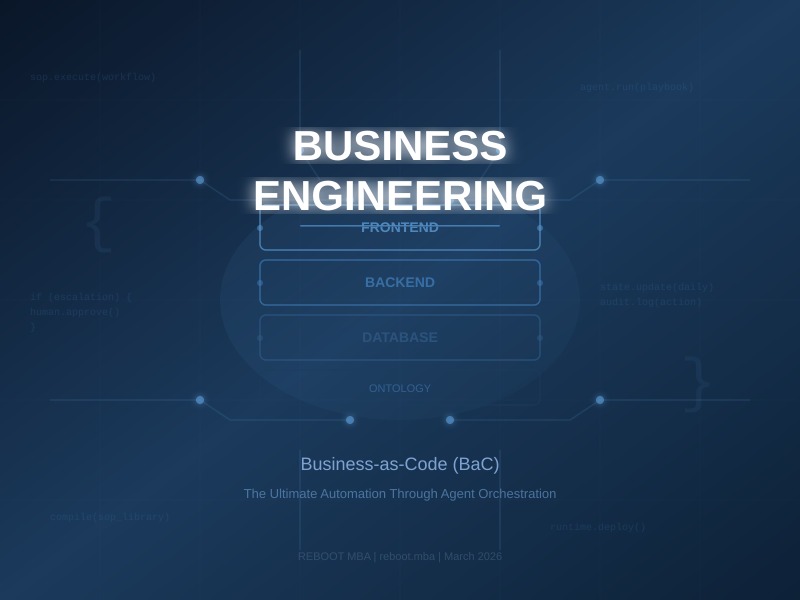
Business Engineering: Business-as-Code (BaC) — The Ultimate Automation Through Agent Orchestration
A research paper on the feasibility of AI-era Full-Stack Business Engineering. Every business is a codebase. SOPs are source code. AI agents are the runtime. This paper introduces Business Engineering as a formal discipline and Business-as-Code as its foundational methodology.

From Profiling to Recommendations: The Shift From Attention to Memory in the Age of AI
As AI agents replace search and feeds with delegated decision-making, digital commerce shifts from profiling attention to owning memory. This transition rewrites incentives, concentrates power, and raises unresolved questions about trust, autonomy, and governance.

Post Knowledge Scarcity: Rebooting Education and Work in the Age of AI
As AI collapses the cost of knowledge transfer, education, talent, and work face a structural reboot. When learning becomes abundant, curiosity and production — not credentials — become the new differentiators.