

From Profiling to Recommendations: The Shift From Attention to Memory in the Age of AI
For most of the internet era, commerce followed a familiar rhythm.
Consumers expressed intent by searching, scrolling, or browsing. Platforms captured that intent, translated it into behavioral profiles, and sold access to it. Advertisers competed for visibility, creators competed for attention, and platforms sat at the center, extracting value from both sides.
This pull-based model — the foundation of the attention economy — shaped everything from search engines to social media to e-commerce marketplaces. It worked because intent was scarce, attention was fragmented, and persuasion could be optimized with money.
Artificial intelligence does not immediately dismantle this system. But it quietly introduces something more fundamental: delegation.
When users no longer search, but ask;
when they no longer browse, but trust;
when they no longer decide, but authorize —
the logic of commerce changes.
What emerges is not simply better recommendations, but a different economic substrate altogether.
The Pull Model and Its Variants
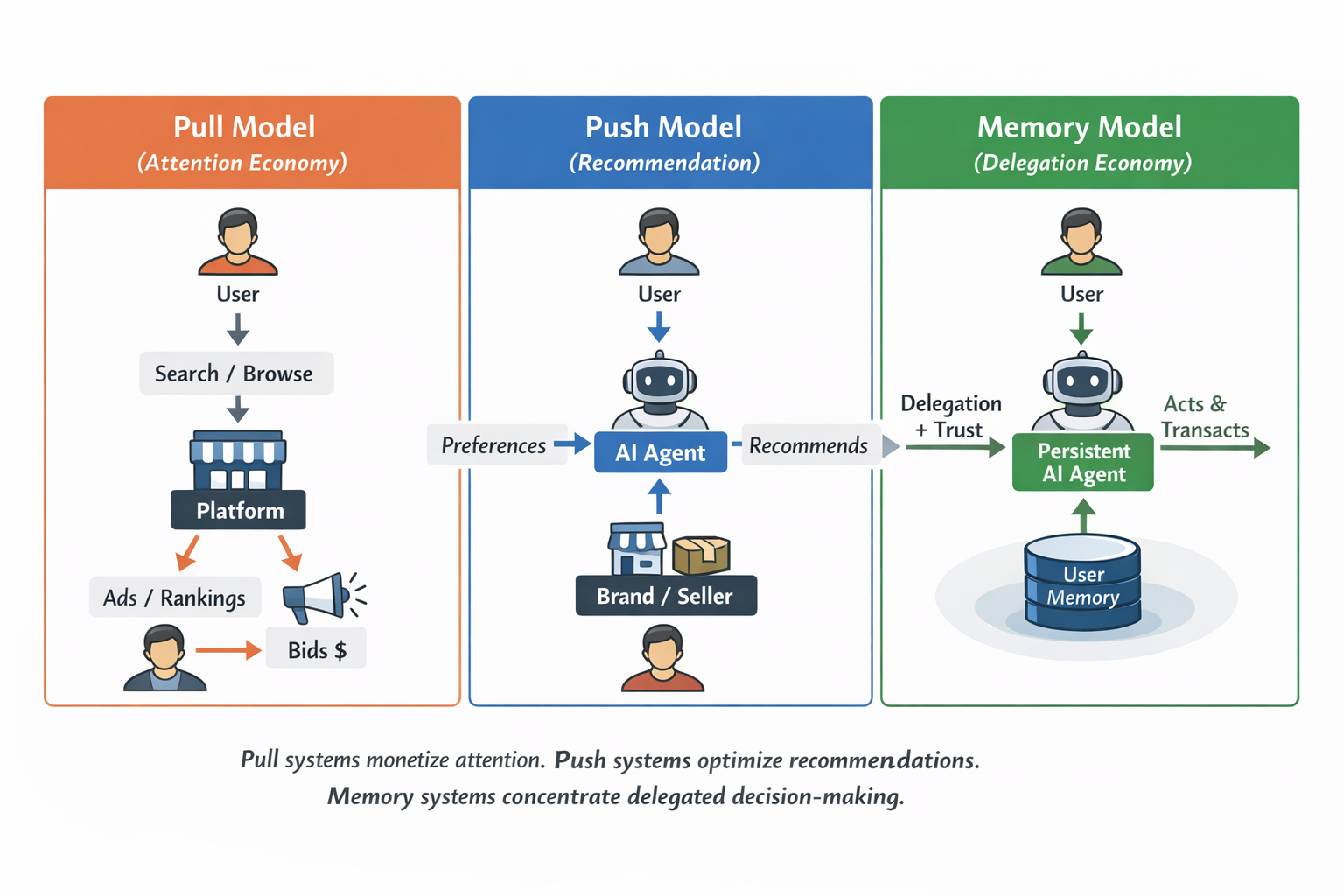
Traditional digital advertising relies on behavioral profiling. Platforms observe what users click, watch, buy, or linger on, and reconstruct probabilistic models of preference. These profiles are monetized through auctions: advertisers bid for exposure, platforms arbitrate placement, and users receive messages optimized for persuasion rather than relevance.
Influencer marketing evolved as a parallel channel within the same logic. Instead of targeting individuals directly, brands route persuasion through trusted intermediaries. Influencers pull attention from audiences and redirect it toward products, often without the infrastructure — or incentives — to verify claims, assess legitimacy, or evaluate long-term consequences for their followers.
The outcomes are familiar. Conversion rates remain low. Trust erodes. Fraud and counterfeit products proliferate. Regulatory scrutiny increases. Yet the system persists because it is economically entrenched and culturally normalized.
The pull model does not disappear simply because a better system exists. People gravitate toward familiarity. Brands rely on habits. Platforms depend on revenue streams that scale predictably.
But the center of gravity is shifting.
The Push Model: Delegated Intent and Agent-Mediated Commerce
Agent-based systems invert the flow. Instead of users pulling information and deciding what to do, they delegate decisions to systems that already know them. These systems do not rely on momentary signals or surface-level behavior, but on persistent memory: preferences, constraints, history, and outcomes.
In this push model, recommendations are not advertisements.
They are actions executed on behalf of the user.
This difference matters. A search result persuades. An agent decides. An ad competes. An agent filters. The economic implications are profound.
Amazon illustrates the tension. Its search business generates tens of billions of dollars annually, thriving on pull-based intent where sellers bid for placement. A true agent-driven model — where an assistant simply buys the best option based on user memory — compresses the funnel, eliminates bidding dynamics, and weakens discovery arbitrage.
Google faces a similar dilemma in search. Walmart, by contrast, has leaned into AI-driven transaction completion, reflecting a different calculus: companies that struggle to control attention often excel at monetizing action. Alibaba’s ecosystem already blurs discovery and execution, making agent-like commerce feel evolutionary rather than disruptive.
What unites these cases is not strategy, but constraint: delegation concentrates power.
From Advertisers to Memory Holders
In the attention economy, platforms depend on advertisers. Even when power is asymmetric, advertisers retain leverage. Budgets move. Auctions discipline placement. Channels diversify.
In a memory-based economy, platforms depend on user trust and delegated authority. Once an agent becomes the interface to commerce, the platform no longer sells access to attention — it controls access to decision-making.
This introduces a new asymmetry. Recommendation algorithms become less persuadable by money and more dependent on internal logic. Market signals flatten. Discovery narrows. And memory — not traffic — becomes the moat.
If a platform knows a user’s financial limits, emotional triggers, health constraints, and personal history, it gains leverage that exceeds anything advertising ever offered. In the user-generated content era, platforms could plausibly claim neutrality. In the agent era, that claim weakens.
Decision systems that infer, recommend, and transact are no longer passive intermediaries.
They are participants.
Influencers, Trust, and Computational Due Diligence
One promise of agent-mediated commerce is improved trust. Influencers today often lack the capacity — and sometimes the incentive — to verify products they promote. Followers assume alignment that may not exist. Scams proliferate in the gap between persuasion and accountability.
An agent operating on behalf of the user could, in theory, perform computational due diligence: evaluating seller history, cross-checking claims, analyzing fulfillment patterns, and rejecting options that fail trust thresholds.
Yet this shifts power again. If agents decide which products are legitimate, who audits the agents? If memory informs trust, who owns the memory?
The line between protection and paternalism is thin.
Attention Economy vs Memory Economy
The attention economy optimizes for visibility.
The memory economy optimizes for alignment.
Pull systems react to intent. Push systems shape outcomes. Search remains pull-triggered but push-ranked. Agents eliminate the trigger altogether.
This is not merely a UX change. It is a redistribution of influence.
Traditional consumer brands invested heavily in websites, funnels, and loyalty programs to own customer relationships. In an agent-mediated future, these assets weaken unless they integrate directly into decision systems. Loyalty becomes behaviorally earned, not point-based. Branding competes with satisfaction history.
Some brands benefit. Others lose autonomy. Platforms arbitrate.
What Remains — and What Concentrates
Traditional marketing will not vanish. Humans remain social, conformist, and comfort-seeking. Familiarity still matters. Culture still shapes desire.
But the gateway to intent — concentrates.
Discovery shifts from feeds and search bars to agents and memory stores. Platforms that control this layer gain unprecedented leverage.
The question is no longer whether AI improves efficiency.
It is whether delegation reshapes power faster than governance adapts.
Unresolved Questions
The transition from profiling to recommendations is not inherently dystopian. It promises lower spam, higher relevance, and better outcomes. But it also introduces new asymmetries history warns us not to ignore.
Can push models exist without recreating new cartels?
Who governs agents that transact autonomously?
Is memory ownership the final leverage point for users?
Are we trading surveillance for delegation — or freedom for convenience?
Once delegation becomes default, it rarely reverses.
Read more
Business Engineering: Business-as-Code (BaC) — The Ultimate Automation Through Agent Orchestration
A research paper on the feasibility of AI-era Full-Stack Business Engineering. Every business is a codebase. SOPs are source code. AI agents are the runtime. This paper introduces Business Engineering as a formal discipline and Business-as-Code as its foundational methodology.

Can Due Diligence Be Computed? Capital Allocation After Knowledge Scarcity
As AI collapses the cost of evaluation and execution, the foundations of venture capital and institutional investing come under pressure. What remains scarce when judgment becomes computational?

Post Knowledge Scarcity: Rebooting Education and Work in the Age of AI
As AI collapses the cost of knowledge transfer, education, talent, and work face a structural reboot. When learning becomes abundant, curiosity and production — not credentials — become the new differentiators.