

Post Knowledge Scarcity: Rebooting Education and Work in the Age of AI
For most of human history, knowledge was scarce.
It lived in books, institutions, guilds, universities, and — most critically — in other people. Learning required proximity to expertise, permission to access it, and time from those who possessed it. Education systems evolved not merely to teach, but to ration this scarcity. Credentials became proxies for access. Degrees became filters. Teachers, mentors, and colleagues were the bottlenecks through which knowledge flowed.
Artificial intelligence does not merely improve this system.
It removes the constraint the system was built around.
This essay explores what happens when knowledge transfer becomes abundant, patient, and scalable — and why, in that world, curiosity and production replace credentials as the primary markers of talent.
I. The Collapse of Knowledge Scarcity
The foundational assumption of education has always been simple: learning is limited by access.
What you could learn depended on:
- what information existed,
- who could explain it,
- how it was transmitted,
- and how much time those people could spare.
AI collapses all four.
Modern language models do not just store information. They explain, translate, contextualize, adapt, and repeat — indefinitely. They do so across domains, at variable depth, and in natural language. They do not fatigue. They do not withhold time. They do not scale linearly with human effort.
Where learning once consumed human attention, it now consumes compute.
This is not an incremental improvement. It is a structural inversion.
The historical constraint was never intelligence.
It was time, patience, and access to other humans.
Those constraints no longer bind.
II. Why “Learning” Must Be Reinterpreted
Most discussions of AI in education focus on surface improvements: automated tutoring, faster content creation, personalized lesson plans, or cheaper access to instructional material. These conversations treat AI as an enhancement to existing educational systems — a better tool inside the same structure.
But this framing understates the disruption.
AI does not merely improve how learning is delivered. It undermines the constraints that historically defined who could learn, what could be learned, and under what conditions learning was possible.
For centuries, learning was gated by access:
By institutions: the prestige and quality of schools, the selectivity of programs, the credibility of teachers.
By economics: who could afford tuition, books, and time without working; who had stable housing, reliable bandwidth, and the cognitive space to focus.
By geography: which cities had good schools, which regions had libraries, which countries had open knowledge systems.
By language: which populations could access the dominant knowledge repositories, and which could not.
By human limits: how much patience a teacher had, how many students they could support, how many times they could repeat an explanation before fatigue set in.
These limits were not incidental. They shaped the entire meaning of education.
Historically, “mastery” was partly competence — and partly endurance under scarcity.
If you could learn, it often meant you had access, time, and someone willing to teach you.
AI disrupts this in a blunt way.
Information is effectively free.
Explanation is effectively unlimited.
Repetition is effectively automated.
Translation is immediate.
Tutoring no longer depends on another human’s patience, schedule, or incentives.
The result is not that people suddenly become equal — economic inequality still exists, and attention is still finite. But the old definition of education begins to crack: when knowledge transfer becomes scalable, institutions lose their monopoly over instruction.
That forces a reinterpretation.
Previously, learning was often treated as acquiring information.
Now, the information is already available — and the explanations can be generated on demand.
So the question becomes unavoidable:
If everyone can learn anything, what matters?
The early answer is uncomfortable because it is not academic.
What matters is not who can access knowledge, but who can:
- choose what to pursue,
- sustain curiosity long enough to go deep,
- develop taste about what is worth building,
- and carry understanding into real-world production.
Education does not disappear in this world.
But its historical role as a gatekeeper of knowledge becomes less defensible — and its filtering function must be rebooted.
III. From Knowledge Gaps to Knowledge Transfer
Historically, learning failures were framed as knowledge gaps: what someone did not know.
In reality, the limiting factor was almost always knowledge transfer.
- Who could teach you?
- How were ideas transmitted?
- How much time could others afford to give you?
- How much repetition was tolerated?
Education systems evolved to manage these frictions. AI eliminates them.
Knowledge transfer is now conversational, adaptive, and effectively infinite. The bottleneck shifts away from institutions and toward individuals.
When learning becomes cheap, attention becomes expensive.
When explanation becomes infinite, curiosity becomes scarce.
IV. The New Scarcity: Curiosity and Completion
Once knowledge is abundant, differentiation reappears elsewhere.
Not everyone asks meaningful questions.
Not everyone sustains inquiry.
Not everyone completes what they start.
The new scarcity is not intelligence or information, but:
- curiosity,
- judgment,
- taste,
- and the ability to carry work end-to-end.
AI does not equalize outcomes. It equalizes opportunity to attempt. What diverges is what people choose to build — and whether they finish.
This marks a quiet but profound shift in how talent reveals itself.
V. Education’s Filtering Function Is Broken
Education has always served two roles:
- transmitting knowledge,
- filtering people.
The second function is now misaligned with reality.
Degrees signal endurance, compliance, and historical access — not necessarily capability. Testing recall is meaningless when explanation is ubiquitous. Credentials lag the world they claim to certify.
The uncomfortable implication is not that education is obsolete, but that education as a sorting mechanism no longer works.
The world no longer needs institutions to decide who is allowed to learn. It needs ways to understand who can create, adapt, and complete.
VI. Production as the New Credential
In the absence of scarcity, output becomes the signal.
Not resumes.
Not grades.
Not titles.
But artifacts.
Projects.
Products.
Systems.
Services.
AI enables individuals to build end-to-end in ways previously reserved for teams. One person can design, code, test, deploy, explain, and iterate. Production becomes legible. Capability becomes observable.
This mirrors shifts already visible in open-source software, independent creators, and portfolio-based hiring — but AI accelerates it dramatically.
Education, in this model, becomes a byproduct of building, not a prerequisite for permission.
VII. The Return of the Producer — Without Losing Scale
Before industrialization, work was holistic. A carpenter built the table. A shoemaker made the shoe. Identity was tied to output and craft.
Industrial systems optimized efficiency by fragmenting work. People became interchangeable parts. Meaning eroded. Entertainment filled the void left by alienation.
AI reverses this tradeoff.
Division of labor collapses not because efficiency is abandoned, but because cognition scales. Individuals regain agency without sacrificing reach. Craft returns — now amplified by machines.
For the first time since industrialization, it becomes possible to combine:
- end-to-end ownership,
- meaningful work,
- and global scale.
VIII. Institutions, Leadership, and Selection
In such a system, organizations change as well.
If individuals can produce independently, leadership shifts from managing effort to selecting outcomes. Judgment, taste, and synthesis replace supervision. Teams become portfolios of creators rather than hierarchies of execution.
Education follows the same logic. Its role is no longer to certify readiness, but to cultivate curiosity, problem selection, and completion.
The open question is how institutions adapt — or whether new ones replace them.
IX. Open Questions for a Post-Scarcity World
If knowledge transfer is no longer scarce, then many inherited structures become unstable.
What replaces degrees when production is the signal?
How is learning recognized without turning into another credentialing cartel?
Who owns the outputs produced with AI assistance — individuals, platforms, or models?
How do we prevent AI-driven education from concentrating power into a few systems?
What happens to identity when work becomes a public artifact rather than a private role?
And how do we ensure curiosity is cultivated rather than optimized away?
These are not technical questions.
They are societal ones.
The age of knowledge scarcity shaped our institutions for centuries.
The age after it has only just begun.
What we choose to build next — in education, in work, and in identity — will determine whether abundance liberates human potential or quietly recentralizes it.
Read more
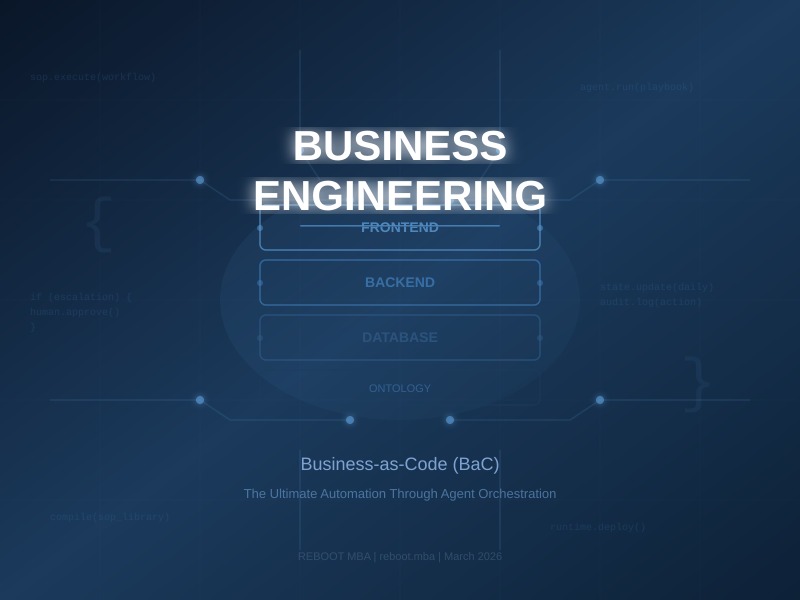
Business Engineering: Business-as-Code (BaC) — The Ultimate Automation Through Agent Orchestration
A research paper on the feasibility of AI-era Full-Stack Business Engineering. Every business is a codebase. SOPs are source code. AI agents are the runtime. This paper introduces Business Engineering as a formal discipline and Business-as-Code as its foundational methodology.

Can Due Diligence Be Computed? Capital Allocation After Knowledge Scarcity
As AI collapses the cost of evaluation and execution, the foundations of venture capital and institutional investing come under pressure. What remains scarce when judgment becomes computational?

From Profiling to Recommendations: The Shift From Attention to Memory in the Age of AI
As AI agents replace search and feeds with delegated decision-making, digital commerce shifts from profiling attention to owning memory. This transition rewrites incentives, concentrates power, and raises unresolved questions about trust, autonomy, and governance.