

Beyond Permissionless: Rebooting Financial Accountability in Web3 and the Age of AI
For over a decade, the debate around financial innovation has been framed as a struggle between decentralization and regulation, disruption and incumbency, freedom and oversight.
This framing is incomplete.
The real fault line in modern finance has never been access to markets.
It has been access to information—and the capabilities required to interpret it.
Historically, this asymmetry has favored the wealthy, the institutional, and the well-advised.
AI fundamentally changes this calculus, not by dismantling institutions, but by democratizing the analytical power once reserved for them.
At the same time, blockchain introduces a simpler, more reliable financial infrastructure—one that mirrors many functions of traditional banking, but without the accumulated technical debt and operational bottlenecks built up over decades.
The future of finance will not be permissionless anarchy.
Nor will it be a return to centralized opacity.
It will be something far more pragmatic: AI-enabled financial capability layered on top of tokenized, verifiable, and accountable financial infrastructure.
1. The Real Inequality in Finance Is Information, Not Access
Retail investors have long been disadvantaged not because they lacked permission to participate, but because they lacked:
- high-quality research
- expert interpretation
- risk modeling
- scenario analysis
- contextual understanding of market structure
- the ability to monitor markets at scale
- tools to evaluate financial products
- timely access to insights
Information asymmetry—not gatekeeping—has historically driven the wealth gap.
AI is the first technology capable of narrowing this asymmetry meaningfully:
- institutional-grade analytics become accessible
- risk becomes explainable
- complex products become interpretable
- contract terms become machine-readable
- market structure becomes transparent
- decision models become personalized
- consumers gain literacy at machine speed
This is the true democratizing force—not the absence of rules, but the availability of intelligence.
2. Traditional Finance Already Resembles Blockchain—Without Its Efficiency
Much of traditional banking functions through processes that mirror blockchain concepts:
- ledgers
- settlement
- reconciliation
- signature verification
- audit trails
- consensus among intermediaries
Yet these processes rely on:
- centralized databases
- fragmented institutions
- overnight batch processing
- manual checks
- operational risk layers
- geographic segmentation
- outdated networks (ACH, SWIFT)
When a deposit in City A takes time to become available in City B, it is not a matter of trust—
it is a matter of infrastructure.
Banks must internally reconcile ledgers before release, effectively simulating what blockchain does natively.
Tokenized ledgers remove this overhead.
They provide cryptographic settlement without teams of engineers orchestrating clearance systems.
This is not ideological; it is architectural.
3. Permissionless Systems Were Not Designed for Consumer Protection
Blockchain’s early promise was “permissionless access”—anyone can transact, create, or deploy.
From an innovation standpoint, this is valuable.
From a consumer-protection standpoint, it is insufficient.
Financial systems require:
- accountability
- dispute resolution
- fraud prevention
- predictable rules
- identity binding
- governance
- recourse mechanisms
Unrestricted participation without corresponding accountability inevitably attracts exploitation.
The answer is not to abandon decentralization, but to recognize that financial fairness depends on verifiable identity, transparent behavior, and enforceable norms.
Compliance is not an adversary; it is foundational to trust.
4. Custodians Are Not Obsolete—But They Should Become Optional
The dichotomy between self-custody and institutional custody is false.
In every mature financial system:
- some individuals prefer autonomy
- most individuals prefer security
The future should allow both.
Tokenized finance enables asset portability, ensuring that:
- users can self-custody if competent
- custodians exist for those who seek managed safety
- switching costs are minimal
- exit is always possible
- infrastructure is interoperable
Custodians become service providers, not gatekeepers.
This restores choice without compromising security.
5. AI Enables a New Kind of Financial Fairness
AI’s role in the future of finance is not limited to oversight.
Its real contribution is capability equalization.
AI can:
- analyze market conditions
- simulate scenarios
- interpret legal terms
- calculate risks
- optimize allocations
- monitor transactions
- detect anomalies
- reduce cognitive load
- generate personalized financial plans
- translate complex contracts into simple language
For the first time, ordinary participants gain tools once exclusive to institutional analysts and quant teams.
This is not speculative—AI models already outperform historical expert benchmarks in:
- credit evaluation
- risk modeling
- financial forecasting
- fraud detection
The playing field becomes more level not because markets are permissionless, but because capability is universalized.
6. Stablecoins Are the Most Practical Expression of Tokenized Finance
The strongest argument for blockchain is not speculative assets.
It is tokenized money.
Stablecoins such as USDC demonstrate:
- near-instant settlement
- negligible transfer fees
- global interoperability
- programmable payments
- transparency of reserves
- simplified treasury tooling
- auditability
Enterprises already use blockchain rails to reduce:
- settlement risk
- FX fees
- reconciliation overhead
- payroll friction
- payment delays
Stablecoins represent a future where value moves at the speed of information, not at the speed of legacy infrastructure.
7. Toward a Hybrid Financial Architecture
The future of finance will not be decentralized maximalism or institutional regression.
It will be a hybrid model with the following characteristics:
1. Tokenized settlement layers
Reliable, verifiable financial rails with global interoperability.
2. Optional custodianship
A spectrum of self-management and institutional trust.
3. AI-enabled financial capability
Universal access to interpretation, analysis, and risk modeling.
4. Structured compliance
Transparent accountability built into the system, not layered on top.
5. Reduced operational complexity
Fewer intermediaries, simpler architecture, lower systemic fragility.
This model is not utopian.
It is simply economically and operationally superior.
8. The Future of Finance Is Not Permissionless—It Is Comprehensible
True financial democratization does not require abandoning institutions or eliminating governance.
It requires systems that:
- are transparent
- are verifiable
- are interoperable
- minimize friction
- reduce asymmetry
- distribute capability
- protect consumers
- promote accountability
- operate efficiently
Blockchain provides the rails.
AI provides the intelligence.
Compliance provides the integrity.
Custodians provide the optional trust layer.
When combined, these elements form a financial system that is both fairer and more resilient than either traditional banking or unbounded decentralization alone.
This is the architecture worth building—and the one that Reboot Finance seeks to examine.
Read more

Chat for Verbs, Menu for Nouns — Essential Product Management Skills for AI Products
Chat as a UI element isn't new. Chat as the primary surface for serious work, with a language model and a harness behind it, is. I want to suggest the chat-versus-menu debate is misframed — and walk through the four design questions I think AI-era PMs should actually be asking.
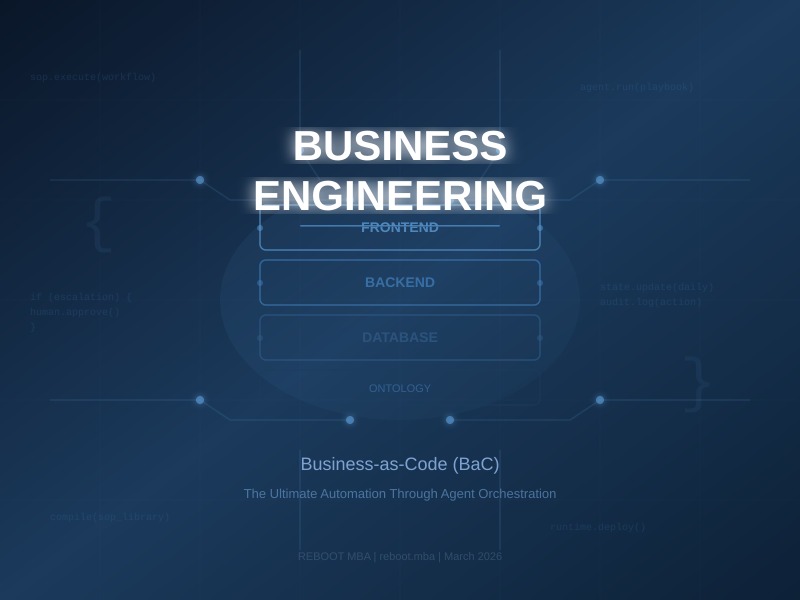
Business Engineering: Business-as-Code (BaC) — The Ultimate Automation Through Agent Orchestration
A research paper on the feasibility of AI-era Full-Stack Business Engineering. Every business is a codebase. SOPs are source code. AI agents are the runtime. This paper introduces Business Engineering as a formal discipline and Business-as-Code as its foundational methodology.

Can Due Diligence Be Computed? Capital Allocation After Knowledge Scarcity
As AI collapses the cost of evaluation and execution, the foundations of venture capital and institutional investing come under pressure. What remains scarce when judgment becomes computational?