

Rebooting Rank-and-Yank: Why Jensen Huang Rejects the GE Management Playbook
For decades, MBA programs worshiped Jack Welch’s GE playbook:
Rank employees across the company, fire the bottom 10% every year, and reward the top.
It became doctrine.
- “Fire fast.”
- “Cut the weakest link.”
- “Only the best survive.”
And for years, it shaped hiring, promotions, and performance reviews across corporate America.
Then Jensen Huang — founder of NVIDIA — walked onto a stage at Cambridge University and said something no MBA textbook would have allowed 20 years ago:
“Firing the bottom 10% is stupid.”
“The last 10% isn’t the problem — the system is.”
This wasn’t just a comment.
It was a death sentence for a pillar of traditional business thinking.
It’s time to reboot one of the most destructive management ideas in MBA history.
1. Jack Welch Built GE in a Static World
To understand why the GE system existed, we need to understand its context:
- Slow-moving markets
- Long project cycles
- Linear org structures
- Predictable career paths
- Limited data about performance
- Top-down control
- Talent as a fixed resource
In that world, Welch’s “rank-and-yank” had a brutal internal logic:
“If performance varies, cut the lowest tail and the whole organization improves.”
But that logic assumed:
- performance is individual
- talent is static
- information is limited
- systems barely matter
These assumptions do not hold in modern AI-driven companies.
2. Jensen Huang Lives in a Nonlinear World
Jensen’s view is built on a different reality entirely:
- High-complexity engineering teams
- Systemic interdependencies
- Extreme collaboration
- Rapid technological change
- Hard problems requiring deep context
- Talent that grows in unpredictable bursts
- Cross-functional knowledge loops
- A nonlinear performance environment
His statement at Cambridge was pointed:
“If the bottom 10% are failing, it means you didn’t train them.”
“The problem is your system, not the people.”
This flips the GE doctrine upside down:
- Talent isn’t fixed → talent is developed
- Weakness isn’t individual → weakness is systemic
- Performance isn’t static → it’s contextual
- Firing isn’t optimization → it destroys culture
NVIDIA’s culture isn’t built on fear.
It’s built on context, learning, and capability compounding.
3. Why Rank-and-Yank Fails in 2025
Here’s what modern AI-era companies understand:
1. Performance is not a bell curve — it’s a network effect.
Great teams make each other great.
Weak systems drag everyone down.
2. Data about performance is contextual, not absolute.
KPI charts can hide boundary conditions, bottlenecks, and systemic constraints.
3. “The bottom 10%” is often a symptom — not a cause.
Low performance signals:
- unclear goals
- badly defined processes
- poor onboarding
- outdated systems
- overloaded seniors
- broken org design
- cultural misalignment
Rank-and-yank kills the messenger.
4. Coaching compounds; firing resets compounding.
Deep tech companies grow talent internally over decades.
You can’t fire your way to capability.
5. AI boosts learning — not elimination.
Employees can now improve faster than ever with AI mentorship and feedback.
The GE model assumes talent declines.
The AI model assumes talent accelerates.
4. The Jensen Huang Model: Systems Over Scapegoats
Jensen’s leadership operates on a different mental model:
1. People struggle because the system failed them.
Not because they are “bad.”
2. The goal is growth, not elimination.
Employees need:
- clarity
- tools
- mentorship
- direction
- psychological safety
- feedback loops
- collaboration
3. Innovation comes from exploration, not fear.
Fear suppresses:
- experimentation
- risk-taking
- creative leaps
AI-era innovation requires the opposite:
- exploration
- rapid iteration
- emotional safety
- cross-disciplinary thought
4. The long tail of performers often produces breakthrough thinkers.
Late bloomers build generational companies.
Early bloomers plateau.
The bottom 10% today
is the breakthrough 5% tomorrow
if you invest correctly.
5. Why KPIs and 360° Reviews Are Becoming Obsolete
Jensen’s critique doesn’t stop at rank-and-yank.
It applies to KPI culture and 360° feedback too.
KPIs
- reward surface-level activity
- conceal systemic issues
- encourage box-ticking
- punish deep work
- distort incentives
360° reviews
- measure popularity
- collapse into political games
- encourage perception management, not performance
- easily weaponized
- destroy psychological safety
Both frameworks reflect the GE-era assumption:
“Humans are predictable performance units.”
The AI-era truth:
Humans are nonlinear systems within other nonlinear systems.
Jensen’s approach treats performance as an emergent property —
not a personal deficiency.
6. The Reboot: Replace Rank-and-Yank With Systemic Intelligence
Here is the modern equivalent of “management” in AI-native companies:
1. Diagnose systems, not individuals
If 10% are failing, it’s a design flaw.
2. Guide performance with AI-assisted coaching
Real-time, context-aware, personalized.
3. Replace KPIs with “feedback loops of clarity”
Clear goals → AI insight → action → iteration.
4. Remove fear from the equation
Fear kills speed, creativity, and collaboration.
5. Shift from elimination → acceleration
Use AI to:
- upskill
- support
- unblock
- enhance
- context-match
6. Build cultures that compound capability
Not cultures that punish variance.
The GE playbook made sense in a static world.
Jensen’s model makes sense in a nonlinear one.
The Reboot
Jensen Huang didn’t just critique rank-and-yank.
He buried it.
He demonstrated that:
- performance isn’t fixed
- teams are systems
- culture compounds
- talent matures irregularly
- fear destroys innovation
- AI changes what “good” means
- the bottom 10% is a mirror, not a target
The GE era rewarded elimination.
The AI era rewards elevation.
Great companies will not be built on firing the weakest.
They will be built on strengthening the system
so the weakest can become essential contributors.
In the age of AI,
the ultimate management skill
is not evaluation.
It is contextual intelligence —
the RebootMBA core principle.
Read more
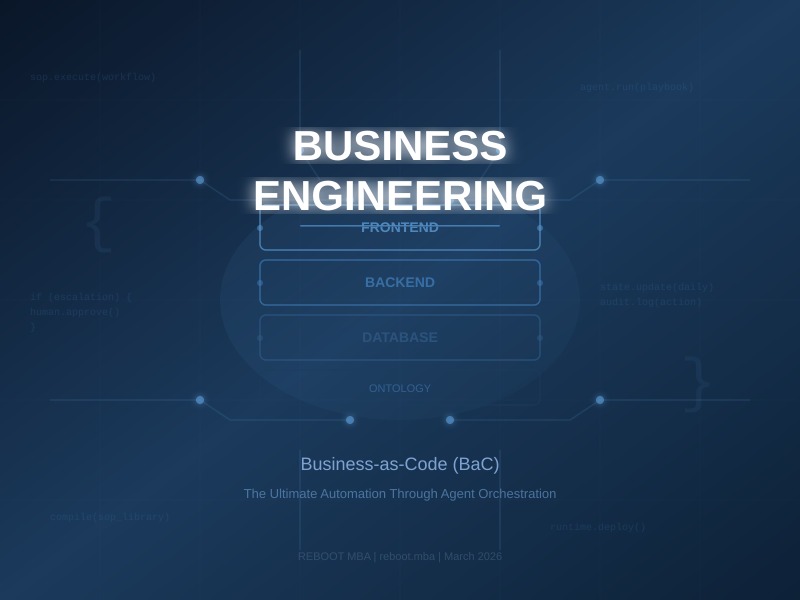
Business Engineering: Business-as-Code (BaC) — The Ultimate Automation Through Agent Orchestration
A research paper on the feasibility of AI-era Full-Stack Business Engineering. Every business is a codebase. SOPs are source code. AI agents are the runtime. This paper introduces Business Engineering as a formal discipline and Business-as-Code as its foundational methodology.

Can Due Diligence Be Computed? Capital Allocation After Knowledge Scarcity
As AI collapses the cost of evaluation and execution, the foundations of venture capital and institutional investing come under pressure. What remains scarce when judgment becomes computational?

From Profiling to Recommendations: The Shift From Attention to Memory in the Age of AI
As AI agents replace search and feeds with delegated decision-making, digital commerce shifts from profiling attention to owning memory. This transition rewrites incentives, concentrates power, and raises unresolved questions about trust, autonomy, and governance.