
The Lean Startup Is No Longer Lean: Why AI Changes Everything
Eric Ries taught an entire generation how to build companies with speed, efficiency, and validated learning.
But that world no longer exists.
The Lean Startup was built on the assumption that resource scarcity creates discipline.
But AI introduces the opposite condition:
Abundance.
Abundant iteration.
Abundant experimentation.
Abundant data synthesis.
Abundant feedback loops.
Abundant “free” intelligence.
Lean Startup was born in a world where humans were the bottleneck.
In 2025, the bottleneck has shifted entirely.
Not learning.
Not iteration.
Not measurement.
The bottleneck is now context.
Understanding what matters — and why — in a world where “validation” itself has become automated.
It’s time to reboot the Lean Startup.
1. The Build–Measure–Learn Loop Has Collapsed
The core Lean Startup loop looked like this:
Build → Measure → Learn
Each step required:
- time
- teams
- experiments
- trade-offs
AI collapses these into near-simultaneous functions.
Modern tools can:
- generate multiple product variations instantly
- simulate user behavior before the product exists
- analyze market data in real time
- generate synthetic user personas
- perform competitor analysis automatically
- validate assumptions through agent-based simulations
The loop no longer runs sequentially.
It runs continuously.
What used to take weeks now happens in minutes.
The world no longer rewards “lean.”
It rewards context-aware acceleration.
2. MVPs Aren’t Minimum Anymore — They’re Maximum Insight Vehicles
Ries defined MVPs as the simplest expression of a hypothesis.
The goal wasn’t the product — it was the learning.
But AI changes the geometry of validation.
A modern MVP might be:
- a landing page with AI-generated copy
- a simulated user onboarding flow
- a synthetic persona interacting with a prototype
- an agent trained on market data to predict demand
- an automated competitor benchmark
- a video demo generated in hours, not weeks
The MVP is no longer a pared-down product.
It is now a maximum insight engine — the fastest path to clarity.
The constraint is not “minimum.”
The constraint is meaning.
3. Customer Development Has Shifted from Interviews to Intelligence
Lean Startup placed huge emphasis on:
- customer interviews
- ethnographic observation
- early adopter signals
But most early adopters no longer know what they want until AI shows them.
Today, customer development is powered by:
- search trend forecasting
- behavioral clustering
- demand modeling
- generative persona simulations
- pattern-based preference extraction
You don’t need to ask 20 customers.
You can model 20,000 synthetic variations of your ideal users.
Customer insight has moved from the street to the model.
4. Pivoting Is No Longer an Event — It’s Continuous
Lean Startup described pivoting as:
A structured course correction based on validated learning.
In 2025, pivots no longer happen as discrete moments.
They happen continuously, because:
- AI surfaces opportunities earlier
- markets shift faster
- competitors adapt in real time
- search behavior updates weekly
- product iteration becomes fluid
- experiments run automatically
Companies don’t pivot.
They flow.
The future organization behaves less like a ship and more like a swarm — adaptive, distributed, constantly reorienting toward signal.
5. “Innovation Accounting” No Longer Measures Learning — It Measures Context
The original framework emphasized metrics such as:
- activation
- retention
- conversion
- engagement
- lifetime value
But in an AI world, these metrics are lagging indicators.
They tell you what happened —
not what will happen.
Modern innovation accounting must measure:
- variance between predicted and actual behavior
- model confidence divergence
- context volatility
- the stability of user intent patterns
- the survivability of an idea under multiple market scenarios
The new KPI is not learning.
The new KPI is contextual accuracy.
How well do you understand the system you’re building in?
6. Lean Startup Assumed Linear Markets. AI Introduces Nonlinearity.
Ries wrote in a world where:
- markets shifted gradually
- competitors responded slowly
- advantage was sustained
- distribution had friction
AI removes these assumptions.
Today:
- a competitor can appear overnight
- distribution is instantaneous
- switching costs are algorithmically reduced
- copycats emerge within hours
- innovation cycles compress from years to weeks
In nonlinear environments, the speed of learning is less important than the depth and context of that learning.
Lean is no longer lean enough.
7. The New Loop: Sense → Simulate → Synthesize → Ship
The modern startup loop looks like this:
Sense
Extract signals from markets, behaviors, networks, and models.
Simulate
Run agent-based predictions and scenario tests.
Synthesize
Generate insight using a blend of AI and human judgment.
Ship
Release fast, update continuously, adapt immediately.
This loop is not a circle.
It is a living system — a perpetual feedback organism.
Startups in 2025 aren’t built the way Ries imagined.
They resemble adaptive neural nets more than factories.
The Reboot
Lean Startup changed how companies were built.
But the environment in which it thrived —
slow-moving, discrete, human-paced — no longer exists.
AI doesn’t invalidate Ries.
It extends him.
It asks new questions:
- What does “validated learning” mean when models can learn instantly?
- What does “minimum” mean when iteration is abundant?
- What does “customer insight” mean when preference can be simulated?
- What does “pivoting” mean when adaptation is continuous?
Lean Startup taught us how to learn.
AI teaches us how to perceive.
The next generation of founders won’t follow Lean Startup.
They will build on it — and reboot it.
Build less.
Learn deeper.
Simulate first.
Ship continuously.
The Lean Startup is no longer lean.
It is something far more powerful:
Context-driven creation.
Read more
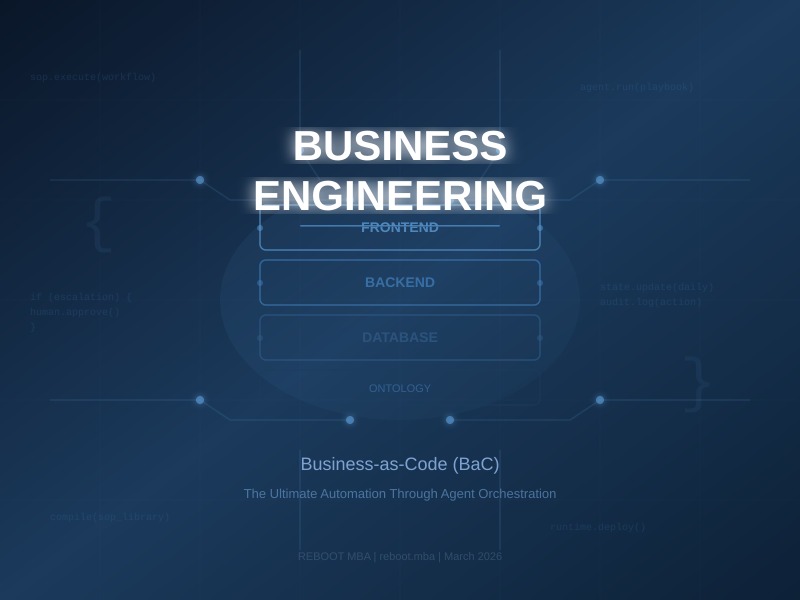
Business Engineering: Business-as-Code (BaC) — The Ultimate Automation Through Agent Orchestration
A research paper on the feasibility of AI-era Full-Stack Business Engineering. Every business is a codebase. SOPs are source code. AI agents are the runtime. This paper introduces Business Engineering as a formal discipline and Business-as-Code as its foundational methodology.

Can Due Diligence Be Computed? Capital Allocation After Knowledge Scarcity
As AI collapses the cost of evaluation and execution, the foundations of venture capital and institutional investing come under pressure. What remains scarce when judgment becomes computational?

From Profiling to Recommendations: The Shift From Attention to Memory in the Age of AI
As AI agents replace search and feeds with delegated decision-making, digital commerce shifts from profiling attention to owning memory. This transition rewrites incentives, concentrates power, and raises unresolved questions about trust, autonomy, and governance.