

Data Doesn’t Drive Decisions — Human Nature Does
For decades, business books and management frameworks have promised the same ideal: better data leads to better decisions.
In the age of AI, dashboards multiply, analytics deepen, and predictions sharpen — yet outcomes remain surprisingly unchanged.
The fundamental truth still holds:
Data doesn’t drive decisions.
Human nature does.
Organizations can automate processes, centralize metrics, and generate perfect forecasts. But the final decision is always made by a human being with incentives, biases, blind spots, fears, ambitions, and constraints. AI can elevate intelligence, but it cannot rewrite psychology.
1. The Real Bottleneck Was Never Data — It Was People
When decisions fail, the root cause is rarely a lack of information.
More often, they fall apart because:
- someone wanted to protect their territory
- someone feared political repercussions
- someone didn’t want to challenge authority
- someone prioritized personal gains over organizational gains
- someone wasn’t rewarded for telling the truth
- someone optimized for appearance, not outcomes
These forces shape real business behavior — far more than analytics, metrics, or insights.
Businesses do not run on spreadsheets.
They run on humans.
2. AI Improves Information Flow, Not Human Behavior
Modern AI systems can:
- summarize complex information
- generate scenarios
- identify hidden risks
- predict outcomes
- highlight contradictions
This dramatically improves informational clarity.
But the behavioral layer remains untouched.
If someone doesn’t want to make a decision, the best AI insight won’t move them.
If someone wants to protect their ego, data becomes ammunition — not guidance.
If incentives reward politics over truth, politics will win every time.
AI exposes misalignment; it does not eliminate it.
3. Most Mistakes Come From Context Gaps — Not Data Gaps
Many bad decisions occur not due to missing data, but due to missing context:
- misunderstanding what truly matters
- interpreting information incorrectly
- applying outdated mental models
- reacting emotionally instead of strategically
- using the wrong problem definition
- assuming others share the same goals
These are contextual blind spots — gaps between what the data says and what people think it means.
AI can reduce confusion and surface clarity, but someone still has to interpret that clarity accurately.
Someone still has to act.
And humans rarely act purely rationally.
4. Decision Intelligence Helps — But It Isn’t a Cure
Decision Intelligence frameworks transform data into structured reasoning:
- mapping consequences
- weighing trade-offs
- visualizing decisions
- revealing hidden variables
- reducing cognitive overload
This raises the baseline quality of decisions.
It eliminates preventable mistakes.
It clarifies priorities.
But it does not override human nature.
At the end of every workflow, scoring model, or simulation, a person chooses what to do — and their choice reflects incentives, values, and psychology, not just evidence.
5. AI Should Augment Humans — Not Replace Judgment
The future of decision-making is not machines taking over human judgment.
It is machines removing noise so human judgment becomes visible.
AI should handle:
- information overload
- pattern detection
- scenario modeling
- forecasting
- summarization
- contradiction detection
Humans should handle:
- values
- ethics
- trade-offs
- prioritization
- accountability
The more information AI automates, the more human nature stands in the spotlight.
Sometimes that clarity is empowering.
Sometimes it’s uncomfortable.
6. The Hardest Question for Modern Leaders
Not:
“Do we have enough data?”
“Do we have the right AI tools?”
But:
“Do we have the courage to confront human behavior?”
“Do our incentives reward honesty or comfort?”
“Do we value truth over politics?”
A leader’s psychology shapes an organization more than any algorithm ever will.
Conclusion
We live in a world where information is abundant, AI is accelerating, and analytics have never been more advanced.
Yet decisions remain unmistakably human.
AI can illuminate the path.
AI can expose inconsistencies.
AI can surface the truth.
But people decide whether to follow it.
Data doesn’t drive decisions — human nature does.
Read more
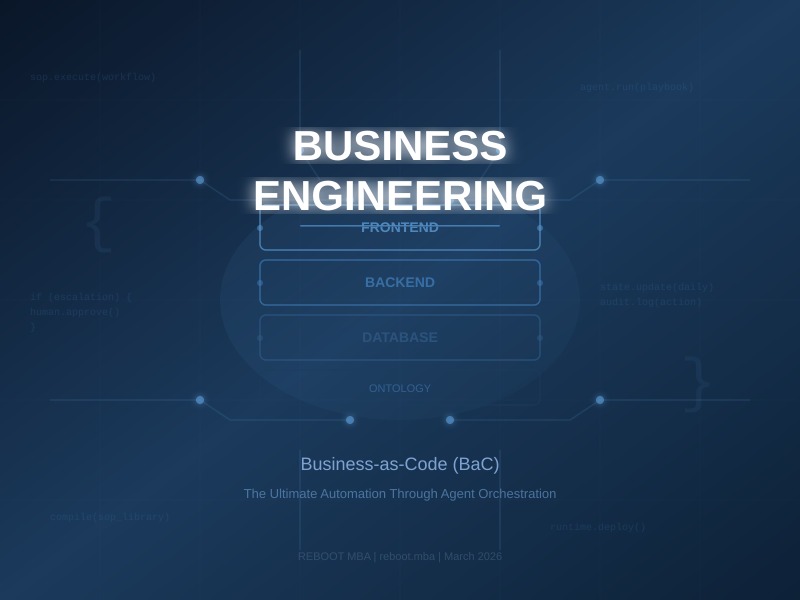
Business Engineering: Business-as-Code (BaC) — The Ultimate Automation Through Agent Orchestration
A research paper on the feasibility of AI-era Full-Stack Business Engineering. Every business is a codebase. SOPs are source code. AI agents are the runtime. This paper introduces Business Engineering as a formal discipline and Business-as-Code as its foundational methodology.

Can Due Diligence Be Computed? Capital Allocation After Knowledge Scarcity
As AI collapses the cost of evaluation and execution, the foundations of venture capital and institutional investing come under pressure. What remains scarce when judgment becomes computational?

From Profiling to Recommendations: The Shift From Attention to Memory in the Age of AI
As AI agents replace search and feeds with delegated decision-making, digital commerce shifts from profiling attention to owning memory. This transition rewrites incentives, concentrates power, and raises unresolved questions about trust, autonomy, and governance.