

Cognition at Scale: The Architecture of AI-Native Companies
Artificial intelligence is transforming how organizations operate, but it has not yet transformed who holds power.
This gap — fast-changing workflows vs. slow-changing hierarchies — is becoming the central tension of the AI era.
A recent perspective from a well-known Asian founder offers a useful starting point:
traditional management exists because human cognition is limited.
AI agents remove many of those limits — continuous memory, persistent state, holistic processing, rapid iteration.
If this is true, then management as a human-centered “cognitive patch” begins to break down.
And organizations built on that patch may struggle to evolve into AI-native enterprises capable of scaling cognition, not hierarchy.
This essay explores whether that transition is feasible for incumbents, how power shifts when cognition scales, and where AI-native startups may challenge both traditional firms and AI mega-labs that increasingly control the substrate of intelligence.
1. The Provocation: Management Was Built for Human Limits
The AI-native thesis is simple:
- Humans forget; AI doesn’t.
- Humans filter; AI sees the whole system.
- Humans tire; AI adapts continuously.
Under this view, the corporation — with its layers, processes, supervision, and corrective systems — is a structure formed around human constraints.
If those constraints disappear,
the structure built around them becomes optional.
In an AI-native company:
- memory becomes a shared, evolving asset
- decisions are validated through simulation rather than seniority
- workflows adapt continuously to new information
- humans shift from process management to intent and values
This is a radical reframing of what an organization is.
But can existing corporations realistically adopt it?
2. Can Corporations Become AI-Native? Technically Yes. Structurally No.
Enterprises can add AI to workflows easily.
But becoming AI-native requires a transformation of power, not technology.
The three immovable barriers:
(1) Structural Inertia
Hierarchies encode decades of political compromise.
Changing a workflow is easy.
Changing who owns the workflow is not.
(2) Incentive Misalignment
AI reduces managerial layers.
Those layers resist their own compression.
(3) Accountability Ambiguity
If a model drives a major strategic decision,
who accepts responsibility for outcomes?
Until accountability is redesigned, AI remains a tool, not an architecture.
Corporations can digitize processes, but cannot easily digitize power.
This is why AI-native companies are more likely to emerge from scratch than from transformation.
3. The Unspoken Question: What If CEOs Become Challengeable?
While early conversation focuses on automation of analysts and operators, a deeper debate is taking shape:
If strategic decision-making is fundamentally an optimization problem,
could AI systems outperform human executives?
Arguments in that direction include:
- models operate with total recall
- models evaluate far more variables
- models simulate scenarios continuously
- models lack ego, fatigue, and political biases
- models can quantify uncertainty and risk in ways humans rarely can
This does not mean AI replaces CEOs.
But it may replace the monopoly CEOs hold over strategic judgment.
The shift is subtle but profound:
- Leadership remains human.
- Exclusive authority does not.
Executives may evolve toward roles defined by:
- intent
- narrative
- ethics
- constraints
- stewardship of long-term direction
In other words, CEOs may move from being strategists to becoming orchestrators.
4. AI-Native Startups vs. AI Cartels: Where Does Power Actually Shift?
Startups theoretically have the strongest advantage in the AI era:
- they begin without organizational debt
- they design workflows around agents, not humans
- their cost structure collapses toward a lean core
- they learn faster and iterate continuously
- their culture aligns with cognition-first design
A five-person AI-native team can perform at the scale of a fifty-person traditional team.
This should make startups dangerous.
But startups face a new barrier no previous generation confronted:
AI Cartels — A New Layer of Gatekeepers
A handful of companies now control:
- foundational model capability
- compute pipelines
- tuning infrastructure
- distribution channels
- access pricing
They control the substrate of cognition —
making startups dependent on platforms that can both empower and limit them.
The strategic landscape becomes:
- innovation decentralized
- intelligence centralized
Startups can still win — but only if they:
- specialize deeply
- differentiate through proprietary or behavioral data
- build unique reasoning engines or workflows
- avoid shallow dependencies on model vendors
- move structurally faster than incumbents or mega-labs
The runway exists, but it is narrower than in previous technology waves.
5. The Reboot Perspective: Extending and Refining the Debate
The cognition-first argument is compelling.
Reboot Principles deepen it through a different lens:
(1) Technology transforms capability; power transforms under pressure.
AI-native design becomes inevitable only when cost and competitive forces make the old structure nonviable.
(2) Decision-making becomes hybrid, not automated.
Models analyze, simulate, and validate.
Humans define purpose, risk appetite, and values.
Governance shifts from authority to orchestration.
(3) Structural advantage, not tooling, determines winners.
AI-native companies win because their architecture makes learning continuous —
not because they use a particular model.
(4) Power redistributes only when the economics of hierarchy break.
When AI-native challengers scale with drastically lower cost,
incumbents must evolve — or be displaced.
(5) The next decade is a competition of operating systems, not industries.
Human-centered management hierarchies
vs.
Cognition-centered adaptive systems
The companies that master the latter
will redefine what “organization” means.
6. AI Changes the Means of Production — Power Will Follow
AI is already reshaping operations,
but power structures lag behind.
The first phase of AI adoption will look like automation beneath traditional hierarchies.
The second phase —
already starting in pockets —
will challenge the hierarchy itself.
Organizations that thrive in this transition will be those that:
- Define intent clearly
- Let AI manage complexity transparently
- Redesign authority around oversight, not ego
- Treat organizational architecture as a competitive advantage
The transition won’t happen uniformly.
Some shifts will come from the top.
Most will come from the bottom.
What is clear:
AI increases cognitive capacity instantly.
Power systems take much longer to update.
The organizations that close this gap fastest
will shape the next era of business.
Read more
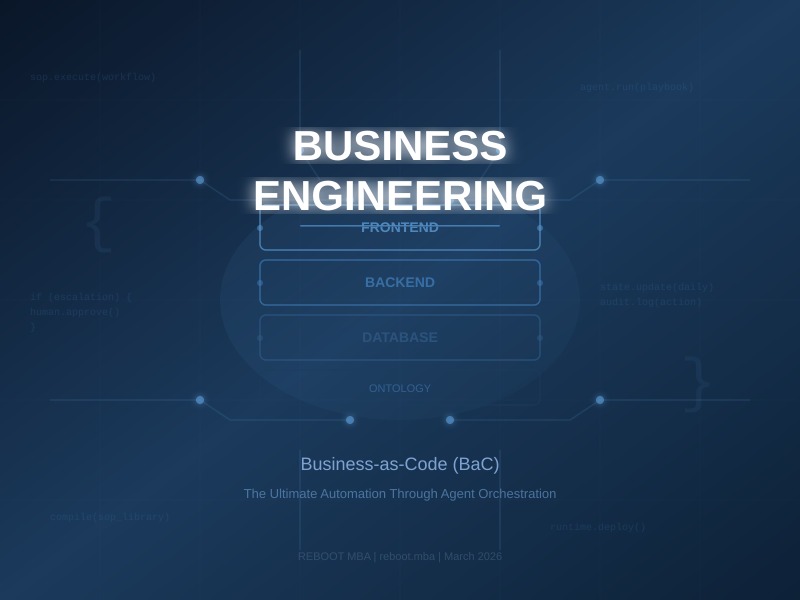
Business Engineering: Business-as-Code (BaC) — The Ultimate Automation Through Agent Orchestration
A research paper on the feasibility of AI-era Full-Stack Business Engineering. Every business is a codebase. SOPs are source code. AI agents are the runtime. This paper introduces Business Engineering as a formal discipline and Business-as-Code as its foundational methodology.

Can Due Diligence Be Computed? Capital Allocation After Knowledge Scarcity
As AI collapses the cost of evaluation and execution, the foundations of venture capital and institutional investing come under pressure. What remains scarce when judgment becomes computational?

From Profiling to Recommendations: The Shift From Attention to Memory in the Age of AI
As AI agents replace search and feeds with delegated decision-making, digital commerce shifts from profiling attention to owning memory. This transition rewrites incentives, concentrates power, and raises unresolved questions about trust, autonomy, and governance.