

Ops Intelligence and the Rise of Decision Intelligence: Lessons From Palantir’s Evolution
Palo Alto, 2003.
While most of Silicon Valley was chasing social networks and lightweight consumer apps, a small team in a modest downtown office was working on something far less glamorous and far more ambitious: building software that could help institutions reason.
Their premise was unconventional for the era. Rather than treating data as something to visualize, they treated it as something to understand. If an organization could be represented through an ontology — a shared model of its entities, relationships, operations, and decisions — then software could surface risks, reveal dependencies, and coordinate actions in ways humans alone could not.
This became Palantir’s defining contribution: Operational Intelligence for systems so large and interconnected that traditional analytics simply couldn't keep pace.
Two decades later, Palantir remains the dominant example of what happens when deep modeling meets real-world complexity. Defense agencies, global manufacturers, and financial institutions use it to bring order to environments where information friction can cost billions — or lives.
But the success of Ops Intelligence creates a new tension in the modern AI era:
If Palantir gave the world’s largest organizations a cognitive layer,
who builds intelligence for the organizations that aren’t large enough to afford one —
but still need to make high-stakes decisions under uncertainty?
And as AI reshapes workflows, knowledge, and strategy itself, is Ops Intelligence still the pinnacle — or merely the foundation for a broader shift toward Decision Intelligence, especially for SMBs, startups, and AI-native teams whose leverage comes not from optimization, but from discovery?
1. What Palantir Actually Achieved: Ops Intelligence at Enterprise Scale
Palantir was built for national security and Fortune-100 environments — places where:
- decisions have cascading consequences
- data is fragmented across agencies and systems
- coordination requires managing thousands of actors
- auditability and compliance are non-negotiable
Its ontology-driven platform reflects that world:
- deep semantic modeling
- fully integrated pipelines
- multi-team operational orchestration
- human-in-the-loop controls
- resilience under extreme uncertainty
This is Operational Intelligence — the art of bringing coherence to massive, complex systems.
Palantir Deployment Reality (Public Estimates)
These figures synthesize government procurement records, industry analysis, and earnings commentary:
| Deployment Factor | Typical Range |
|---|---|
| Year-1 Contract Value | $7M–$50M+ |
| Multi-year TCV | $50M–$300M+ |
| Integration Timeline | 6–24 months |
| Ontology Modeling | 3–12 months |
| Data Engineering Lift | Internal teams + Palantir support |
These numbers aren’t criticisms — they reflect the nature of enterprise-scale transformation.
You don’t rewire a global supply chain or defense ecosystem with a weekend integration.
2. Why Ops Intelligence Is Less Impactful for SMBs and Startups
Palantir’s architecture thrives where processes are:
- stable
- deeply interconnected
- optimized for consistency
- large enough that a 1–2% efficiency gain moves the needle
But this is not the reality for smaller organizations.
Not because they lack sophistication —
but because they have different strategic physics.
The Real Constraints
(1) Cost Barriers
A $7M–$50M first-year deployment is not economically viable for a 30–300 person company.
(2) Time-to-Value Barriers
SMBs and startups pivot strategy faster than a 12–24 month integration cycle.
(3) Strategic Asymmetry: Optimization vs. Exploration
Large enterprises win by optimizing what already works.
Smaller companies win by discovering what could work.
This difference shapes everything.
Enterprise vs SMB Reality
| Category | Palantir (Enterprise) | SMB / Startup Reality |
|---|---|---|
| Deployment Cost | $7M–$50M+ | Not economically feasible |
| Integration Timeline | 6–24 months | Requires days–weeks to adapt |
| Ontology Complexity | Requires domain teams + structured processes | Processes evolve as the business discovers itself |
| Strategic Leverage | 1–2% optimization → massive business impact | Growth hinges on finding new markets or leverage points |
| Core Strategic Need | Defense: protect and optimize scale | Offense: create scale and discover opportunity |
Why Ops Intelligence Matters Less for SMBs
Because their absolute upside lives in discovery, not optimization.
They need intelligence that acts as leverage, not refinement.
And that is the domain of Decision Intelligence.
3. Decision Intelligence: The Offense Strategy
Where Ops Intelligence optimizes the known,
Decision Intelligence helps teams navigate the unknown.
For SMBs and startups, DI delivers:
- insight into emerging customer signals
- comparative analysis of strategic paths
- capital allocation support
- cross-functional knowledge access
- faster iteration cycles
- reduction in uncertainty when choosing where to bet
In this world:
Decision Intelligence isn’t an analytics layer —
it’s a leverage engine.
It gives small teams the ability to think and act like larger, more experienced organizations.
But DI matters for enterprises too — just for different reasons.
4. Decision Intelligence for Enterprises: Avoiding Strategic Failure
In large organizations, DI strengthens leadership rather than replacing it.
(1) Fixing Upward Information Flow
Executives often receive filtered or delayed data.
DI surfaces weak signals and contradictions that would never have reached them.
(2) Fixing Downward Strategy Transmission
Even when vision is clear, execution often fragments.
DI creates a shared operational picture.
(3) Challenging Intuition-Based Decision Patterns
Model-assisted reasoning forces better tradeoff evaluation.
(4) Scaling Scenario Modeling
Enterprises can simulate:
- pricing
- supply chain stress
- workforce allocation
- competitive positioning
Ops Intelligence defends the present.
DI defends the future.
5. Why AI-Native Tools Change the Equation Entirely
(1) No More Heavy Ontology Upfront
AI-native DI learns from:
- documents
- conversations
- logs
- semi-structured data
You don’t need a year of modeling before seeing value.
(2) Deployment in Days, Not Years
This matches the tempo of SMBs and startups.
(3) Designed for Ambiguity
Startups reconfigure themselves quarterly.
AI-native DI thrives under fluid objectives.
(4) Democratization of Cognitive Power
Enterprise tooling concentrated insight.
AI-native DI distributes it.
6. From Ops to DI to AI-Native: An Evolution, Not a Replacement
Palantir answered a 2000s-era question:
“How do we coordinate and understand massive organizations?”
The 2020s introduce a different question:
“How do smaller, faster-moving teams make better decisions under uncertainty?”
Ops Intelligence solves the first.
Decision Intelligence solves the second.
AI-native design will solve both — eventually — but in different ways.
- Enterprises: optimize scale, avoid misalignment
- SMBs & startups: find leverage, explore opportunity
Different physics, different needs, different intelligence layers.
7. Defense vs. Offense: The Split That Now Defines Intelligence
Enterprises
- Win by scale and consistency
- Benefit enormously from operational optimization
- Need Ops Intelligence as a defensive capability
- Use DI to prevent expensive strategic errors
SMBs & Startups
- Win by speed and insight
- Gain more from discovering the right bet than optimizing existing ones
- Need DI as an offensive capability
- Rely on AI-native tools to reduce information asymmetry
Ops Intelligence gave the largest institutions a way to see themselves more clearly.
Decision Intelligence gives the rest of the world a way to choose more wisely.
The first era belonged to the enterprises that needed orchestration.
The next era belongs to the organizations — new and old — that need leverage.
And in an economy where speed of learning beats size of footprint,
that shift may prove even more disruptive than the first.
Read more
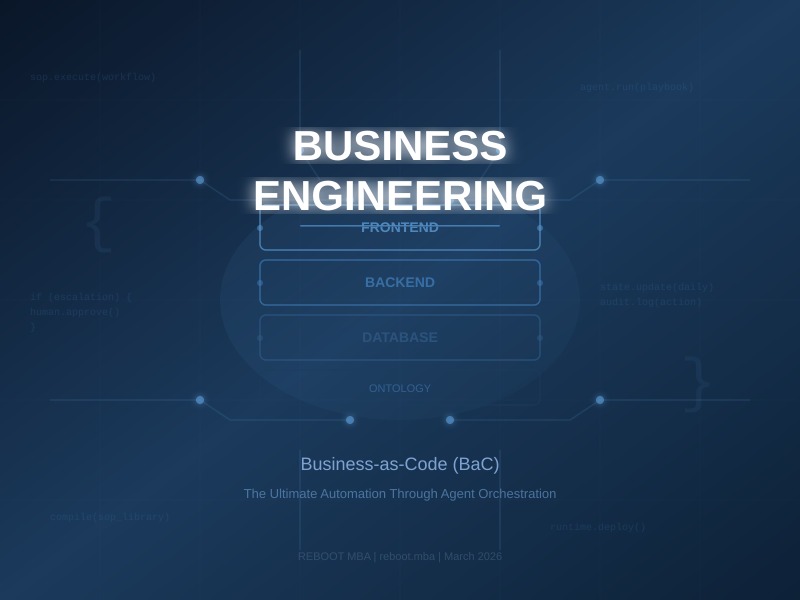
Business Engineering: Business-as-Code (BaC) — The Ultimate Automation Through Agent Orchestration
A research paper on the feasibility of AI-era Full-Stack Business Engineering. Every business is a codebase. SOPs are source code. AI agents are the runtime. This paper introduces Business Engineering as a formal discipline and Business-as-Code as its foundational methodology.

Can Due Diligence Be Computed? Capital Allocation After Knowledge Scarcity
As AI collapses the cost of evaluation and execution, the foundations of venture capital and institutional investing come under pressure. What remains scarce when judgment becomes computational?

From Profiling to Recommendations: The Shift From Attention to Memory in the Age of AI
As AI agents replace search and feeds with delegated decision-making, digital commerce shifts from profiling attention to owning memory. This transition rewrites incentives, concentrates power, and raises unresolved questions about trust, autonomy, and governance.