

LLM’s True Transformative Power Is Qualitative, Not Quantitative
For more than a decade, companies invested aggressively in quantitative infrastructure: data warehouses, cloud pipelines, BI dashboards, and increasingly refined analytics teams.
The last tech cycle optimized everything that could be quantified. It gave us precision, increasingly beautiful visualizations, and an unprecedented volume of measurable signals.
So when large language models (LLMs) arrived, leaders naturally assumed they would deliver deeper numerical insight — faster forecasting, more accurate dashboards, and even sharper quantitative analysis.
But LLMs’ true strength was not in numbers.
It was in language — in modeling relationships, interpreting context, and assigning meaning.
And in doing so, they pushed AI into a domain businesses had never been able to automate:
Qualitative cognition.
That shift reframed everything.
It is the difference between looking at the vital signs on a medical monitor and having a doctor walk into the room and say:
'Here’s what this means — and here’s what you should do next.'
Businesses had monitors for years.
What they lacked was the doctor.
LLMs didn’t leapfrog quantitative analytics —
they finally explain them.
Inside every enterprise, this shift is exposing a truth leaders have quietly known for years: the bottleneck was never data collection; it was data understanding.
Dashboards, no matter how beautiful or interactive, were never designed to explain themselves.
They could show patterns but not meaning.
They could reveal anomalies but not interpret their implications.
Quantitative tools told the organization what was happening.
LLMs finally tell it why.
And with decision intelligence, they help organizations understand what to do next.
For years, people assumed AI would primarily automate the quantitative — forecasting, optimization, modeling. And to a large extent, data science already conquered that realm long before LLMs.
The true disruption is that generative AI now automates the qualitative:
insight, synthesis, reasoning, prioritization, and argumentation.
In practice, companies have always relied on humans to bridge the gap from data to insight.
- Analysts translated dashboards.
- Directors contextualized metrics.
- Consultants synthesized insights across teams.
- Tribal knowledge filled in what BI tools could not.
The most valuable leadership function in every organization was the scarce ability to make sense of complexity.
But now, qualitative interpretation itself is computational.
That doesn’t diminish human judgment —
it elevates it.
LLMs take on the cognitive heavy lifting, processing thousands of signals across finance, product, operations, customer behavior, and market data, weaving them into narrative clarity.
They do what no dashboard has ever done:
collapse noise into meaning.
Quant tells you your churn is rising.
Qual tells you why customers are leaving.
Quant tells you inventory is piling up.
Qual tells you where demand was misread.
Quant tells you revenue is flat.
Qual tells you which bets could bend the curve.
By unlocking the qualitative frontier, LLMs transform the quantitative world from isolated metrics into a cohesive map.
The organization goes from reading numbers to understanding its own internal logic.
This fusion — quantitative precision + qualitative cognition — is the real disruption.
Each alone is powerful; together, they behave like an entirely new form of institutional intelligence.
It marks a quietly revolutionary transition:
Businesses no longer suffer from a lack of information,
but from a lack of cognition.
LLMs supply cognition at scale.
And cognition is the superpower organizations have been missing —
the connective medium between data, insight, and action.
The result is a new decision-making paradigm where leadership shifts from wrestling with dashboards to evaluating synthesized arguments.
The interpretive layer is no longer a bottleneck.
Insight no longer depends on proximity to tribal knowledge.
The organization begins to think with a single, aligned cognitive system.
The Reboot Principle
The last cycle optimized what could be measured.
This cycle will optimize what can be understood.
The fusion of quantitative systems and qualitative intelligence will redefine how companies think, decide, and compete.
The companies that master this shift won’t just have better analytics.
They will have a cognitive advantage —
a living, evolving intelligence that understands their business with a clarity no dashboard alone could ever provide.
Read more
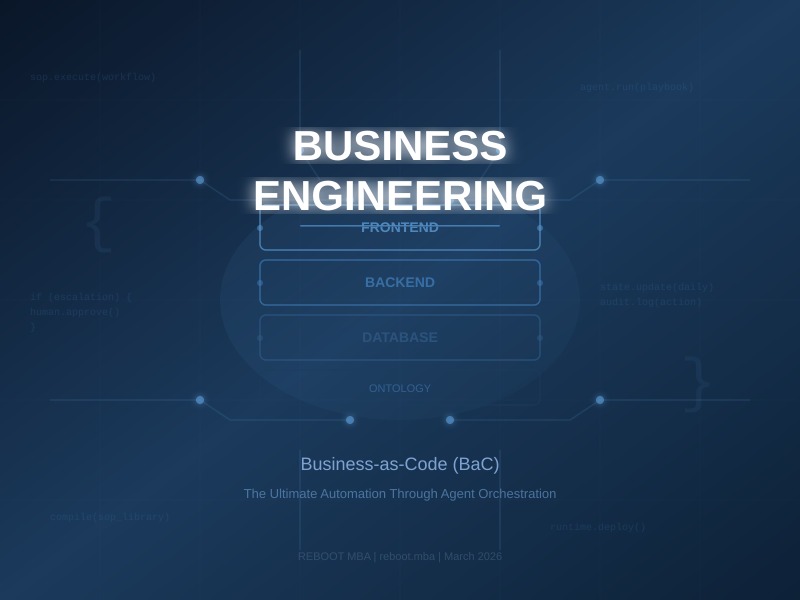
Business Engineering: Business-as-Code (BaC) — The Ultimate Automation Through Agent Orchestration
A research paper on the feasibility of AI-era Full-Stack Business Engineering. Every business is a codebase. SOPs are source code. AI agents are the runtime. This paper introduces Business Engineering as a formal discipline and Business-as-Code as its foundational methodology.

Can Due Diligence Be Computed? Capital Allocation After Knowledge Scarcity
As AI collapses the cost of evaluation and execution, the foundations of venture capital and institutional investing come under pressure. What remains scarce when judgment becomes computational?

From Profiling to Recommendations: The Shift From Attention to Memory in the Age of AI
As AI agents replace search and feeds with delegated decision-making, digital commerce shifts from profiling attention to owning memory. This transition rewrites incentives, concentrates power, and raises unresolved questions about trust, autonomy, and governance.