
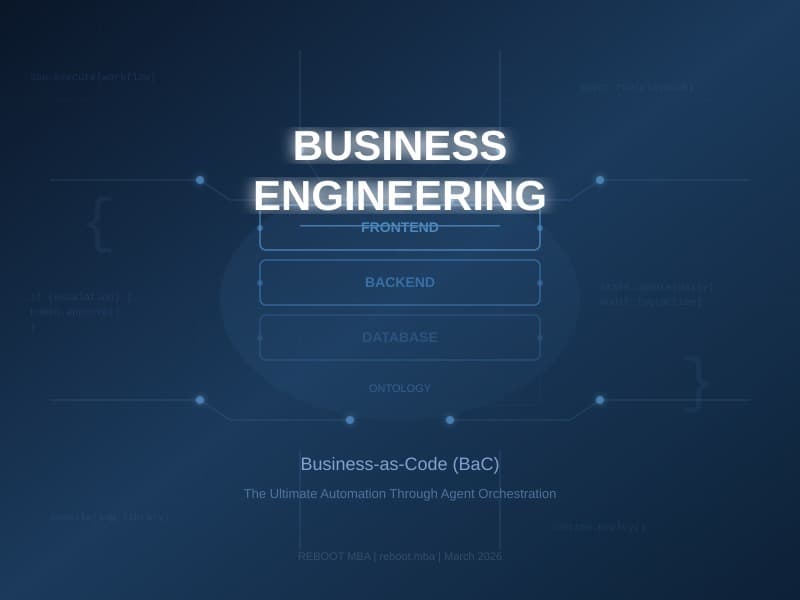
Business Engineering: Business-as-Code (BaC)
The Ultimate Automation Through Agent Orchestration
A Research Paper on the Feasibility of AI-Era Full-Stack Business Engineering
Abstract
This paper introduces Business Engineering as a formal discipline and Business-as-Code (BaC) as its foundational methodology. Drawing a rigorous structural mapping between software architecture and business operations, we propose that every business can be decomposed into a full-stack system comprising a Frontend (customer-facing operations), Backend (operational logic), and Database (state and assets) layer, governed by an Ontology that defines entities, relationships, and transitions.
We argue that Standard Operating Procedures (SOPs) are functionally equivalent to source code: they encode business logic that can be compiled into executable agent workflows and run by AI agents in real-time. This paper examines the feasibility of this approach in the current AI landscape, provides a comprehensive analysis of human inefficiencies in business execution, from attention fragmentation and cognitive overload to corruption, political maneuvering, and misaligned incentives, and proposes a new model for the future workforce built on five essential human roles: Storyteller, Analyst, Operator, Builder, and Seller.
We introduce the concept of the Business Compiler and Business Runtime, positioning AI agent orchestration platforms as the infrastructure layer that makes Business-as-Code operational, observable, and continuously optimizable.
1. Introduction: The Software Metaphor Becomes Literal
For decades, business thinkers have used software metaphors loosely. Phrases like "run your business like a machine" or "systematize your operations" populate management literature without rigor. These metaphors gesture toward efficiency but lack architectural precision.
The emergence of Large Language Models (LLMs) and autonomous AI agents transforms this metaphor from aspirational analogy into engineering specification. For the first time, natural-language instructions — the format in which all business SOPs are written — can be parsed, interpreted, and executed by computational systems. This means that the entire operational logic of a business, previously locked inside human cognition and tribal knowledge, can now be formalized, compiled, and run as code.
Business Engineering is the discipline of designing, building, testing, deploying, and maintaining businesses as engineered systems. Business-as-Code (BaC) is its core methodology: the practice of encoding all business logic in structured SOPs that serve as the source code for AI-executed operations. Full-Stack Business Engineering is the accessible reference for understanding that every business, like every software application, has a frontend, backend, and database that must be architected together.
This paper establishes the theoretical framework, maps the architecture, examines feasibility in the current AI landscape, and addresses the critical question of human roles in a code-executed business.
2. The Full-Stack Business Architecture
Every modern software application consists of a frontend, backend, and database layer. We propose that every business, regardless of industry or scale, can be decomposed into an analogous three-layer stack, unified by an Ontology layer that defines the schema of the business itself.
2.1 Frontend: The Customer-Facing Layer
In software, the frontend is the interface through which users interact with the system. In Business Engineering, the frontend encompasses every touchpoint where external stakeholders (customers, partners, investors, regulators) interact with the business:
- Product experience and service delivery (the primary UI)
- Marketing, brand communications, and content (the design system)
- Sales conversations and customer support (interactive components)
- CRM systems as frontend state management, tracking customer lifecycle, engagement, and conversion status
Growth operations — including acquisition, activation, retention, and referral — function as the business equivalent of user acquisition and engagement pipelines. Just as a software frontend must be responsive, intuitive, and continuously optimized through A/B testing, the business frontend must be data-driven, customer-centric, and iteratively improved.
2.2 Backend: The Operational Logic Layer
The backend is where business logic lives. In software, the backend processes requests, applies rules, and returns results. In Business Engineering:
- SOPs are the business logic functions, defining how inputs are processed into outputs
- Partnerships and vendor relationships are API integrations, defining how external systems connect
- Supply chain and logistics are data pipelines, moving resources through transformation stages
- Internal communications are the event bus, carrying signals between components
- Management decisions are control flow statements: conditionals, loops, and exception handling
The backend is where most business complexity resides, and where most inefficiency accumulates. Human execution of backend logic is subject to cognitive overload, attention fragmentation, misinterpretation, inconsistency, fatigue, and, as we will examine in Section 4, a comprehensive set of structural failures ranging from corruption to political maneuvering.
2.3 Database: The State and Assets Layer
Every business maintains state. In Business Engineering, the database layer encompasses:
- Financial records: balance sheets, P&L, cash flow — the core state tables
- Talent and human capital: skills, availability, performance — the most dynamic dataset
- Inventory and physical assets: tracked, versioned, and queried
- Intellectual property and proprietary knowledge: the business equivalent of configuration and secrets
- Customer data: relationships, transactions, preferences, behavioral patterns
- Compliance and legal records: data integrity constraints that govern all operations
The database layer must maintain ACID properties: Atomicity (transactions complete fully or not at all), Consistency (business state adheres to defined rules), Isolation (concurrent operations do not create conflicts), and Durability (state changes persist reliably). Most business failures can be traced to violations of these properties at the organizational level.
2.4 The Ontology Layer: Business Schema
In software, an ontology defines entities, their attributes, and their relationships. In Business Engineering, the Ontology layer provides the schema that governs the entire stack:
- Assets: what the business owns, controls, and can deploy
- Relationships: how entities connect, depend on, and influence each other
- States: the current condition of every entity (active, pending, at-risk, completed)
- Transitions: what causes entities to change state (triggers, conditions, thresholds)
This maps directly to a business dynamics framework built on three primitives:
| Primitive | Software Equivalent | Business Meaning |
|---|---|---|
| Stocks | State variables, database records | Current quantities: cash, inventory, headcount, pipeline value |
| Flows | Rate of state change, transactions per second | Revenue rate, burn rate, hiring velocity, churn rate |
| Feedback | Event listeners, monitoring alerts, CI/CD triggers | Customer signals, market response, operational metrics that modify flows |
3. SOPs as Source Code: The BaC Methodology
The central thesis of Business-as-Code is that Standard Operating Procedures are functionally equivalent to source code. This is not a metaphor. It is a structural claim with specific implications.
3.1 Structural Equivalence
| Software Concept | BaC Equivalent | Example |
|---|---|---|
| Function / Method | Individual SOP | "Process customer refund request" |
| Module / Package | Playbook (domain-specific SOP collection) | "Growth Playbook", "Ops Playbook" |
| Codebase | Complete business SOP library | All SOPs across Product, Growth, Ops |
| Variables / State | Business metrics, KPIs, entity states | "ARR = $2.4M", "Pipeline stage = Negotiation" |
| API Calls | Cross-department handoffs | "Sales passes qualified lead to Onboarding" |
| Error Handling | Escalation procedures | "If approval denied, escalate to VP" |
| CI (Continuous Integration) | SOP version control and validation | "New refund SOP tested against existing workflows before going live" |
| CD (Continuous Deployment) | Deploying updated SOPs to runtime | "Updated pricing SOP deployed; agents execute new logic immediately" |
| Unit Tests | SOP validation and compliance checks | "Audit: did process follow SOP?" |
3.2 The Four Domains
Business-as-Code organizes the entire business codebase into four domains:
Kernel Domain: The foundational layer containing business identity, metadata, shared configuration, team structure, and cross-domain governance rules. The Kernel is referenced by all other domains and changes infrequently — analogous to environment variables and global configuration in software systems.
Product Domain: Encompasses product development, service delivery, quality assurance, and customer experience. This is what the business builds and delivers.
Growth Domain: Encompasses marketing, sales, partnerships, community, brand, and distribution. This is how the business acquires and retains customers and expands its reach.
Operations Domain: Encompasses finance, HR, legal, compliance, infrastructure, and team management. This is the engine that keeps the business running and accountable.
Every business activity maps to one of these four domains. Every SOP belongs to a playbook within one of these domains. The complete set of playbooks across all four domains constitutes the business codebase.
4. The Human Inefficiency Problem: Why Code Outperforms Human Nodes
The case for Business-as-Code is not merely about automation efficiency. It addresses fundamental structural failures inherent in human-executed business operations. These failures span cognitive, attentional, ethical, social, and organizational dimensions.
4.1 The Attention Crisis: Productivity's True Bottleneck
Every human employee's productive output is fundamentally attention-driven. Attention is the scarcest resource in any organization, yet modern work environments are architecturally designed to destroy it.
The average knowledge worker context-switches every three to five minutes. Each switch incurs a cognitive penalty of fifteen to twenty-five minutes to regain deep focus. Across an eight-hour workday, this means a typical employee may spend more time recovering from interruptions than performing focused work. The tools meant to enhance productivity — including email, instant messaging, notifications, and collaborative documents — have become the primary destroyers of the attention they were designed to support.
This is not a personal failing. It is a systemic architecture problem. Every application on every device is competing for the same finite cognitive resource. The attention economy, which drives consumer technology, has metastasized into the workplace. Slack notifications, email threads, calendar invitations, and dashboard alerts create a continuous stream of interruptions that fragment the very concentration required to execute complex business logic.
AI agents do not have attention. They have compute. This is a categorical, not incremental, advantage. An AI agent executing an SOP does not check its messages, does not get distracted by a colleague's question, does not lose twenty minutes recovering from a context switch. It processes the workflow from trigger to completion with deterministic focus. When multiplied across an entire organization, the aggregate attention savings represent the single largest productivity gain Business-as-Code delivers.
4.2 Cognitive Limitations
Beyond attention, human operators are subject to well-documented cognitive constraints that directly impair business execution:
- Working memory limits: humans can hold approximately seven items in working memory simultaneously. Complex business processes routinely exceed this threshold, leading to errors, omissions, and the constant need for external memory aids (notes, checklists, reminders) that themselves consume attention.
- Inconsistency: the same human executing the same SOP on different days will produce variable results based on fatigue, mood, distraction, health, sleep quality, and cognitive load. Two different humans executing the same SOP will produce even greater variance.
- Bottlenecks: human processing speed creates natural throughput limits. A single decision-maker approving requests creates a queue that scales linearly. In code, approval logic can be parallelized or automated within defined parameters.
- Knowledge silos: critical business logic stored in individual minds is lost when employees leave, creating institutional amnesia. The business equivalent of undocumented code that no one can maintain after the original developer departs.
4.3 Context Switching: The Hidden Tax
Context switching deserves separate treatment because its costs are so widely underestimated. When a human moves from a sales call to a financial review to a product design decision, each transition imposes a cognitive reset. The mental models, terminology, emotional register, and decision frameworks differ for each domain.
Studies in cognitive psychology consistently show that multitasking does not exist; what humans experience as multitasking is rapid sequential switching with compounding efficiency losses. A human who handles four different business functions in a day may operate at sixty to seventy percent of their potential capacity in each, compared to one hundred percent for an AI agent that can run four parallel workflows simultaneously without any degradation.
For founders and small teams, this tax is devastating. A startup founder who serves as Storyteller, Analyst, Builder, Seller, and Operator in a single day may be the most context-switching-burdened worker in any organization. Business-as-Code offloads the execution layer of each role to AI agents, allowing the human to operate at the strategic and creative layer where context switching is less costly.
4.4 The Communication Overhead: The Coordination Tax
As organizations grow, the number of communication pathways increases exponentially. For n people, the number of potential one-to-one communication channels is n(n-1)/2. A team of 10 has 45 potential channels. A team of 50 has 1,225. A company of 500 has 124,750.
Meetings, emails, Slack threads, standups, all-hands, syncs, and retrospectives exist primarily because human nodes need to synchronize state with each other. Each person maintains a local copy of their understanding of the business state, and communication is the mechanism by which these local copies are reconciled.
In a BaC architecture, AI agents share state through the ontology directly. There is one source of truth, updated in real-time, accessible to all agents simultaneously. The need for state-synchronization meetings drops to near zero. Human communication can then focus on what it does best: creative collaboration, relationship building, and strategic deliberation — rather than information relay.
4.5 Ethical Failures, Corruption, and Self-Dealing
Beyond cognitive and attentional limitations, human nodes introduce ethical vulnerabilities that code-level execution architecturally eliminates:
- Kickbacks and corruption: in many business environments, particularly cross-border operations, every level of the value chain may extract unauthorized value. Anti-corruption enforcement at the human level has proven consistently inadequate regardless of policing intensity, regulations, or oversight mechanisms. No amount of human compliance infrastructure has solved this problem, because the problem is architectural: humans with discretionary authority and opaque decision processes will inevitably face temptation that some percentage will act on.
- Self-dealing: human agents with decision authority may optimize for personal benefit rather than organizational benefit — a principal-agent problem that has plagued organizations since their inception. From padding expense reports to steering contracts to preferred vendors, self-dealing exists on a spectrum from petty to catastrophic.
- Bias and favoritism: hiring, promotion, vendor selection, and resource allocation are all subject to human biases that are difficult to detect and nearly impossible to eliminate through policy alone. Training programs and diversity initiatives address symptoms, not the structural reality that human decisions are inherently subjective.
- Information asymmetry exploitation: individuals with privileged access to business information may use it for personal advantage, from insider trading to selective disclosure to clients or competitors.
At the code level, these problems become architecturally addressable. CRM interactions, business development workflows, partnership negotiations, and financial approvals can all be executed through transparent, auditable agent workflows where every decision is logged, every criterion is explicit, and every deviation from protocol is flagged. The defense against corruption is not any single agent's incorruptibility — as AI systems themselves can exhibit emergent behaviors and be influenced by adversarial inputs — but rather the architecture itself: SOPs that define objective criteria, audit trails that log every action, and human oversight gates at critical decision points.
4.6 Political Maneuvering: The Productivity Drain Nobody Measures
In every human organization of meaningful size, a significant portion of employee energy is spent on internal politics: credit-claiming, blame-avoidance, alliance-building, territory-defending, and status-positioning. These activities produce zero business value. They exist because human organizations are simultaneously professional structures and social hierarchies, and humans cannot help but navigate both.
The cost of political maneuvering is nearly impossible to measure because it masquerades as legitimate work. The meeting that exists to establish dominance looks like a strategy session. The email chain that assigns blame looks like a post-mortem. The project that exists to justify a department's headcount looks like innovation.
AI agents have no career ambitions, no ego, no territory to defend, and no status to protect. They execute the defined objective and report the result. The organizational energy currently consumed by political dynamics could be redirected entirely toward value creation.
4.7 Training, Onboarding, and Knowledge Decay
Every new human node requires weeks to months of onboarding before reaching productive capacity. During this period, existing employees are diverted from their own work to train the newcomer. The total cost of onboarding — including reduced productivity, trainer time, error rates during the learning curve, and institutional knowledge transfer — is estimated at one to two times the employee's annual salary.
More critically, human knowledge degrades over time. As SOPs evolve, human understanding lags. The employee trained six months ago is operating on a partially outdated mental model. The employee trained two years ago may be executing processes that no longer match current best practices. This knowledge decay is invisible until it produces an error or a compliance failure.
AI agents "onboard" instantly by reading the current SOP and execute the latest version every time. When an SOP is updated, every agent executing that process immediately operates on the new logic. There is no training period, no knowledge decay, and no version mismatch between what the process should be and what is actually executed.
4.8 Emotional Interference and Health-Related Performance Degradation
Human employees are whole people. They bring their personal lives, health conditions, stress levels, relationship dynamics, and emotional states to work every day. A team member going through a divorce, dealing with a sick parent, managing financial anxiety, or struggling with insomnia will perform at a fraction of their capacity, sometimes for weeks or months.
This is not a criticism of human nature. It is an observation about the structural vulnerability of systems that depend on human cognitive performance. A business process that requires consistent, high-quality execution cannot reliably achieve it when the executor's personal circumstances are a variable that changes daily and is invisible to the system.
AI agents are not subject to emotional interference, health fluctuations, or life events. Their execution quality is constant. This does not mean businesses should lack empathy for their human employees; it means the execution layer should not depend on factors that are inherently unpredictable and uncontrollable.
4.9 Misaligned Incentives
The principal-agent problem is perhaps the oldest unsolved challenge in organizational design. Employees are hired to pursue the organization's objectives, but they inevitably also pursue their own: career advancement, compensation maximization, workload minimization, and status accumulation. These personal objectives frequently conflict with organizational objectives in ways that are difficult to detect and expensive to correct.
The entire apparatus of performance reviews, KPIs, incentive structures, and management oversight exists to align employee behavior with business goals. This alignment infrastructure is itself a massive cost center that produces imperfect results. AI agents, governed by SOPs, execute the defined business logic without deviation, gaming, or strategic underperformance. The alignment problem, for the execution layer, is architecturally solvable — though vigilance is required as AI systems themselves can develop emergent goal-seeking behaviors that deviate from intended objectives.
4.10 The Comprehensive Cost-Benefit Calculus
When comparing human nodes to AI agent nodes across all dimensions of business execution, the calculus is decisive:
| Dimension | Human Nodes | AI Agent Nodes (BaC) |
|---|---|---|
| Attention | Finite, fragmented, competitive | Unlimited, dedicated, parallel |
| Speed | Hours to days per decision cycle | Seconds to minutes |
| Consistency | Variable, degraded by fatigue and emotion | Deterministic within defined parameters |
| Context Switching | 15-25 min recovery per switch | Zero-cost parallel execution |
| Scalability | Linear (add more humans) | Elastic (spin up more agents) |
| Coordination Cost | Exponential (n*(n-1)/2 channels) | Constant (shared ontology) |
| Corruption Risk | Inherent, difficult to eliminate | Mitigated by SOPs + audit trail |
| Political Overhead | Significant, unmeasurable | None |
| Onboarding | Weeks to months, knowledge decays | Instant, always current |
| Incentive Alignment | Requires costly oversight apparatus | SOP-governed (no personal objectives) |
| Cost | Salary + benefits + overhead | Compute cost (declining rapidly) |
| Availability | 8-12 hours/day, 5 days/week | 24/7/365 |
4.11 What Humans Do That Code Cannot
The preceding analysis identifies where AI agents outperform human nodes in business execution. However, a complete assessment must also recognize the capabilities that remain irreducibly human — not as a concession, but as a design requirement for any viable BaC architecture.
- Accountability and legal responsibility: someone must sign, testify, and bear legal consequences. AI agents cannot be held liable. Every business ultimately needs humans who say "the buck stops here."
- Experiential intuition: pattern recognition from lived experience that has not been codified. The seasoned operator who senses something is wrong before the data confirms it. This is compressed wisdom from years of domain exposure that no training dataset fully captures.
- Physical world presence: shaking hands, reading a room, visiting a factory floor, sitting across from a client. The physical dimension of business remains irreducibly human.
- Creative origination: not content generation (AI does that effectively), but genuine novel vision. The insight that creates a new category, the product idea that does not yet exist, the strategic pivot that defies conventional logic.
- Ethical judgment in gray areas: where SOPs do not have an answer, where the right decision requires weighing competing values, where cultural context and moral reasoning intersect in ways that cannot be reduced to rules.
- Trust-building through authenticity: humans trust humans. The seller who builds a twenty-year client relationship, the founder whose personal story inspires investors, the leader whose presence stabilizes a team in crisis.
- Adaptability in unstructured environments: situations with no playbook, no precedent, no SOP. Humans improvise. Agents execute. When the environment is genuinely novel, human adaptability is the only resource available.
Business-as-Code does not seek to eliminate these human capabilities. It seeks to free them from the burden of routine execution so they can be applied where they matter most.
5. The Business Compiler and Runtime
If SOPs are source code, then the business needs a compiler to parse them into executable form and a runtime to execute them. This is the architectural role of AI agent orchestration platforms.
5.1 The Compilation Process
In traditional software, a compiler transforms human-readable source code into machine-executable instructions. The Business Compiler performs an analogous transformation:
- Parsing: SOPs written in natural language are parsed into structured workflow definitions, identifying triggers, conditions, actions, and outputs.
- Semantic analysis: the compiler validates that SOPs reference valid entities in the business ontology, that handoffs between SOPs are properly defined, and that all edge cases have defined escalation paths.
- Dependency resolution: the compiler maps dependencies between SOPs, identifying which processes must complete before others can begin, and which can execute in parallel.
- Optimization: redundant steps are identified, bottlenecks are flagged, and execution paths are optimized for throughput and latency.
- Agent assignment: each compiled workflow step is assigned to the appropriate executor — whether an AI agent, a human node, or an external system integration.
5.2 The Runtime Environment
The Business Runtime executes compiled workflows in real-time against the live business ontology:
- Event-driven execution: business events (customer inquiry, invoice received, candidate applied) trigger the appropriate SOP workflows automatically.
- State management on a daily cadence: the runtime maintains the current state of all business entities. Consistent with the turn-based nature of business operations, most state updates occur on a daily cycle, with real-time triggers reserved for time-sensitive events such as customer inquiries or urgent escalations. This daily cadence reduces noise and enables strategic reflection.
- Human-in-the-loop channels: the runtime routes decisions requiring human judgment through structured channels:
- Action Required: items present predefined response options for rapid one-click decisions
- Notifications: status updates and alerts
- Live Feed: real-time observation and persistent audit trail, filtered by role-based access control
- Reports: daily state summaries and analytics
- Exception handling: when workflows encounter conditions not covered by existing SOPs, the runtime escalates to human operators and logs the exception for future SOP development.
- Observability: every execution step is logged, measured, and visualized, providing operational intelligence across the entire business stack.
5.3 Context Assembly: The COPE Framework
A critical challenge in any BaC runtime is delivering the right information to the right actor at the right moment. We introduce the COPE Framework as a systematic approach to context assembly:
- Context: the current focus, task, or decision point that the actor (human or AI) is addressing
- Ontology: the full business playbook and state — the complete schema of entities, relationships, and dynamics that governs the business
- Perspective: role-based access control that determines what each actor is authorized to see and do, ensuring information security while enabling appropriate access
- Experience: how information is presented and interacted with, including interface modality (mobile, desktop, conversational), visualization style, and interaction patterns optimized for the actor's role and situation
COPE ensures that every interaction with the Business Runtime — whether by a human reviewing an action-required item or an AI agent executing a workflow step — is grounded in the appropriate context, informed by the relevant ontology, scoped to the correct perspective, and delivered through an optimal experience.
5.4 Deployment: Launching a Business
In Business-as-Code, "deployment" takes on a literal meaning. Launching a business — or a new business unit, or expanding into a new market — follows the same pattern as deploying a software application:
- Write the SOPs (source code) for all four domains: Kernel, Product, Growth, Ops
- Compile them through the Business Compiler, validating logic and dependencies
- Instantiate human nodes (hire the five essential roles)
- Instantiate AI agent nodes (configure agents for automated execution)
- Connect to the ontology (integrate with data systems, financial systems, CRM)
- Deploy to production (launch operations)
- Monitor, debug, and iterate (continuous improvement through feedback loops)
Scaling the business means the same thing as scaling a software system: adding more agent capacity, expanding the ontology to accommodate new entities and relationships, and writing additional SOPs for new operational domains.
5.5 Business Templates: Starter Kits and the Democratization of Operational Excellence
In software development, starter kits and project scaffolding tools allow developers to bootstrap a complete application stack by answering a few configuration questions. The same principle applies to Business-as-Code.
An AI-powered onboarding process can interview a business owner or representative — asking structured questions about their industry vertical, revenue model, team size, target market, and operational requirements — and then generate a complete SOP codebase from a pre-built industry template. This is the business equivalent of running a project scaffolding tool: answer the configuration questions, and receive a fully structured business stack with default playbooks across all four domains, pre-configured workflows, best practices embedded, default AI agent assignments, and starter KPIs and metrics — all customizable from day one.
This concept has a powerful precedent in one of the most successful business models in history: franchising.
The Franchise Parallel
Franchise systems are, at their core, businesses sold as operational templates. A franchise package typically includes an operations manual (which is an SOP library), marketing playbooks (brand guidelines, approved messaging, campaign templates), financial SOPs (standardized bookkeeping, reporting templates, required systems), training programs (onboarding curricula for new employees), and quality audit procedures (inspections to verify SOP compliance).
The most successful franchise organizations in the world — from fast food to hospitality to retail — have demonstrated for decades that standardized SOPs, rigorously followed, produce consistent, high-quality business outcomes regardless of who operates the individual unit. This is the BaC thesis proven at scale through human execution.
Business-as-Code takes the franchise model and transforms it in three fundamental ways:
- Fully customizable: unlike a franchise agreement that mandates strict adherence to corporate standards, BaC templates are starting points that can be modified, extended, and adapted to any business context. The template provides the structure; the business owner provides the customization.
- AI-executed: the human labor layer that franchises still require (cashiers, support staff, administrators) can be partially replaced by AI agents executing the same SOPs. The template does not just tell humans what to do; it executes through agents directly.
- Living and adaptive: a franchise manual is static until corporate issues an update. A BaC template continuously improves through feedback loops — the runtime observes what works, the Analyst identifies optimization opportunities, and SOPs evolve in real-time.
This creates a powerful democratization effect: BaC templates give every business access to franchise-grade operational sophistication without the franchise model's costs, restrictions, or royalty payments. A solo operator deploying an industry-vertical BaC template can run a business with the operational consistency of a franchise, at a fraction of the overhead.
The logical extension is a template marketplace — an ecosystem where industry experts, experienced operators, and domain specialists publish, share, and sell pre-built BaC templates for specific verticals and use cases, much as developers today sell SaaS themes, boilerplates, and starter kits. This marketplace would accelerate BaC adoption by lowering the barrier to entry: instead of writing every SOP from scratch, a new business can start from a proven template and customize from there.
6. The New Workforce: Five Essential Human Roles
Business-as-Code does not eliminate humans. It fundamentally redefines their role from execution nodes to strategic, creative, and evaluative functions. Through extensive analysis of what businesses irreducibly require from human participants, we identify five essential roles that cannot be fully automated and that form the human backbone of any BaC organization.
6.1 The Storyteller
Every business needs a human who can craft and communicate the narrative: the vision, the brand, the mission, the pitch. Storytelling is the most fundamentally human business function because it requires emotional resonance, cultural awareness, authenticity, and the ability to connect with other humans at a level that transcends information transfer.
The Storyteller defines the brand voice, communicates the company vision to investors and customers, translates product capabilities into human value propositions, and maintains the narrative coherence that gives a business its identity. AI can generate content, but it cannot originate the authentic human story that differentiates one business from another.
Attributes from BaC: The Storyteller functions as the business architect of the frontend layer, defining how the world perceives and connects with the business. They evaluate market positioning, authorize brand decisions, and steward the most important relationship of all: the one between the business and its audience.
6.2 The Analyst
The Analyst is the business equivalent of a DevOps engineer and data scientist combined. They monitor the runtime, interpret the data, identify patterns, diagnose problems, and recommend SOP improvements. In a BaC organization, the Analyst's role is elevated: they are not crunching numbers in spreadsheets but interpreting the real-time output of the Business Runtime, identifying where the business codebase needs refactoring, and designing experiments to optimize business logic.
The Analyst evaluates whether the ontology accurately represents reality, whether feedback loops are producing the expected signals, and whether the stocks-flows-feedback dynamics are healthy. They are the business equivalent of the engineer who reads the production logs and says "this system needs attention here."
Attributes from BaC: The Analyst serves as the primary evaluator and auditor of the business system, continuously assessing whether the code (SOPs) matches the reality (market conditions, customer behavior, competitive landscape).
6.3 The Operator
Operations encompasses the broadest set of business functions: finance, legal, HR, compliance, team management, infrastructure, and administrative processes. The Operator ensures the business engine runs reliably, legally, and sustainably. They manage the business equivalent of infrastructure and platform engineering.
In a BaC organization, the Operator's role shifts from manual process execution to system oversight. AI agents handle the routine: payroll processing, compliance checks, invoice management, scheduling. The Operator focuses on exception handling, regulatory interpretation, people management (which remains irreducibly human), and the strategic decisions that keep the organization functional and legally sound.
Attributes from BaC: The Operator is the decision authority for operational matters, the accountability node for legal and financial compliance, and the architect of the backend and database layers of the business stack.
6.4 The Builder
The Builder creates. In a software company, the Builder writes the code, designs the product, and ships the features. In a non-technical business, the Builder designs the service, creates the offering, and delivers the value. The Builder is the human who translates vision into reality — the one who takes the Storyteller's narrative and the Analyst's insights and produces the thing the business actually sells.
In a BaC organization, the Builder also writes the business codebase itself: the SOPs, the playbooks, the workflows. The Builder understands both the business domain and the BaC methodology well enough to encode business logic into executable form. They are the software engineer of the business system.
Attributes from BaC: The Builder is the primary architect of the business codebase, the designer of the product domain, and often the most cross-functional role, touching Product, Growth, and Ops. In early-stage companies, the Builder is typically the founder.
6.5 The Seller
Revenue is oxygen. The Seller is the human who converts interest into commitment, prospects into customers, and pipeline into revenue. While AI agents can qualify leads, send follow-ups, schedule meetings, and even conduct initial discovery conversations, the high-stakes moments of business development — where trust is built, objections are handled with emotional intelligence, and commitment is secured — remain fundamentally human.
The Seller also serves as the most direct feedback channel from the market. They hear objections before they appear in data, sense shifts in customer sentiment before they show up in churn metrics, and understand competitive dynamics from the front lines. In a BaC organization, the Seller's market intelligence feeds directly into the business ontology, creating a feedback loop between market reality and business logic.
Attributes from BaC: The Seller is the primary relationship steward for revenue-generating interactions, the frontline evaluator of market conditions, and the human node in the growth domain whose judgment and emotional intelligence cannot be replicated by agents.
6.6 The Five Roles as a Complete System
These five roles — Storyteller, Analyst, Operator, Builder, and Seller — constitute the minimum viable human team for any business operating on the BaC methodology. In early-stage companies, one person may occupy multiple roles (a founder who is simultaneously Builder, Storyteller, and Seller). In larger organizations, each role may expand into teams. But the five archetypes remain constant.
The attributes traditionally associated with organizational roles — such as architect, evaluator, decision authority, relationship steward, and auditor — are not separate positions in a BaC organization. They are capabilities distributed across the five essential roles. The Analyst evaluates. The Operator decides and audits. The Storyteller and Seller steward relationships. The Builder architects. Every essential role carries multiple attributes, and every attribute maps to at least one essential role.
| Role | Primary Domain | Key BaC Attribute | AI Augments | Human Irreplaceable |
|---|---|---|---|---|
| Storyteller | Growth | Architect, Steward | Content drafts, distribution | Authentic narrative, vision |
| Analyst | All Four | Evaluator, Auditor | Data processing, pattern detection | Interpretation, judgment |
| Operator | Operations | Authority, Auditor | Routine processing, compliance | Legal accountability, people mgmt |
| Builder | Product | Architect | Code generation, testing | Design, creativity, SOP authorship |
| Seller | Growth | Steward, Evaluator | Lead qualification, follow-up | Trust-building, negotiation, EQ |
6.7 The Accountability Framework: RACI
A critical concern with AI-executed business operations is accountability. Who is responsible when an agent makes a bad decision? Business-as-Code addresses this through the RACI framework applied to every SOP and decision point:
- Responsible: the executor of the task, whether an AI agent or a human. SOPs are authored and approved by named humans who bear responsibility for the logic they encode.
- Accountable: the human who bears the consequences of the outcome. Every material decision has a named accountable party from among the five essential roles.
- Consulted: subject matter experts and cross-functional stakeholders who provide input before decisions are finalized.
- Informed: the chain of command and relevant stakeholders who are notified of decisions and outcomes, with defined escalation rights to intervene when necessary.
Agent actions are logged and auditable, creating a complete chain of causation from SOP to execution to outcome. The Business Runtime provides real-time observability, so deviations from expected behavior are detected immediately rather than discovered in quarterly reviews.
7. The Job Transition Map: From Execution to Engineering
The transition to Business Engineering does not eliminate jobs. It restructures work across four categories: roles that remain with AI augmentation, roles that transform, roles that emerge, and roles that diminish.
7.1 Roles That Remain
These roles exist today and will continue, but with dramatically expanded capability per person:
- Sales professionals become Revenue Strategists. AI handles lead qualification, outbound, CRM updates. Humans focus on high-stakes relationship closing and market intelligence.
- Legal counsel remains human for accountability, judgment, and regulatory interpretation. AI handles document review and compliance checking.
- Creative directors and brand leaders remain as Storytellers. AI generates and distributes content. Humans originate vision and authentic narrative.
- Executive leadership retains accountability, vision-setting, and stakeholder trust.
- People managers continue managing humans with empathy and conflict resolution, though managing fewer people with deeper focus.
7.2 Roles That Transform
These roles exist today but will be fundamentally reconceived. Critically, the transformation is often not a change in the person's expertise, but a change in their output format:
- Business Analysts and Product Managers evolve into SOP authors and optimizers. They still apply deep domain expertise, but their deliverable shifts from reports and slide decks to executable business logic. Their business knowledge becomes more valuable, not less, because it is now encoded in a form the Business Runtime can execute.
- Project Managers become Orchestration Managers who manage agent workflows and runtime health rather than human task lists.
- Customer Support Representatives evolve from frontline responders to escalation specialists handling complex situations requiring empathy and judgment.
- Financial Controllers shift from routine bookkeeping to financial strategy, interpretation, and audit oversight as part of the Operator role.
- HR Managers shift from administrative processing to strategic people management, culture building, and talent development.
7.3 Roles That Emerge
These roles do not exist in meaningful numbers today:
- SOP Engineers / Business Logic Engineers: professionals who write, test, debug, and optimize business SOPs as executable logic. This hybrid role combines domain expertise with systematic thinking about how to encode business rules for agent execution.
- Agent Operations Engineers: the DevOps/SRE equivalent for AI agent systems. They monitor agent performance, handle failures, tune execution parameters, and manage the runtime environment.
- Business Compliance Engineers: professionals who audit agent decisions, ensure regulatory compliance of automated workflows, and manage the accountability trail.
- Ontology Architects: professionals who design and maintain the business schema — the entities, relationships, states, and transitions that govern the entire system.
- Context Engineers: professionals who design how information is assembled and presented to different actors using frameworks like COPE, ensuring the right context reaches the right decision-maker at the right moment.
7.4 Roles That Diminish
Certain roles will see significantly reduced demand as BaC adoption spreads. Individuals in these roles should be supported in transitioning toward the transformed or emerging positions described above:
- Data entry and manual processing roles are largely automated through SOP-driven agent execution.
- Routine first-line customer support for common inquiries is handled by agents, with humans reserved for complex escalations.
- Middle management roles focused primarily on coordination and information relay diminish as the shared ontology eliminates the need for human state-synchronization.
7.5 The Rise of One-Person Companies and Micro-Teams
Perhaps the most profound structural shift enabled by Business-as-Code is the dramatic reduction in the minimum viable team. A solo founder who previously was crushed by context-switching across all five essential roles can now offload the execution layer of each role to AI agents, operating at the strategic level across all domains simultaneously.
A five-person BaC team with AI agents can compete with a fifty-person traditional organization. A solo operator with the right platform can compete with a five-person team. This creates a new category: the AI-Native Solo Operator — a single person who architects the business codebase, deploys it through the Business Runtime, and manages by exception rather than by execution.
The result is not fewer enterprises, but a long tail of highly capable micro-businesses that were previously impossible to operate at their level of sophistication.
8. Feasibility in the Current AI Landscape
The feasibility of Business-as-Code depends on the current capabilities and trajectory of AI systems, particularly Large Language Models and AI agent frameworks.
8.1 What Is Feasible Today
- Natural language SOP parsing and execution for well-defined, structured processes
- Multi-agent orchestration for workflows involving 3-10 sequential or parallel steps
- Real-time state management through integration with existing business tools (CRM, ERP, communication platforms)
- Human-in-the-loop routing for approval and escalation workflows
- Audit logging and observability across agent actions
- Attention and context-switching elimination for routine operational processes
8.2 What Requires Near-Term Advances (12-24 Months)
- Reliable multi-step reasoning across 20+ step workflows with branching logic
- Cross-domain context maintenance (agent that handles a customer issue spanning Product, Growth, and Ops)
- Robust error recovery without human intervention for common failure modes
- Standardized SOP-to-agent compilation tooling
- Real-time ontology synchronization across distributed systems
8.3 What Requires Longer-Term Development
- Full autonomous execution of complex negotiations and relationship management
- Creative and strategic decision-making at the executive level
- Self-modifying SOP systems that evolve business logic based on outcomes without human review
- Complete replacement of the Seller role in high-stakes, trust-dependent transactions
The trajectory of LLM capabilities, combined with advances in agent frameworks, tool use, and memory systems, suggests that the "near-term" capabilities will be achievable within the current technology curve. The longer-term capabilities represent genuine open research questions.
9. Implications and the Category-Defining Opportunity
Business Engineering and Business-as-Code represent more than an incremental improvement in business operations. They represent a category shift in how businesses are conceived, built, and operated.
- For founders: Business Engineering provides a systematic, debuggable, testable approach to building companies — the same way they architect software, using debuggable, testable, versionable business logic instead of intuition and tribal knowledge.
- For investors: BaC organizations produce unprecedented operational transparency. Every process is documented, every metric is real-time, every decision is auditable. Due diligence becomes a code review.
- For employees: the shift from execution to the five essential roles represents a fundamental upgrade in the nature of work. Storytellers, Analysts, Operators, Builders, and Sellers operate at a higher cognitive and creative level than process executors.
- For society: transparent, auditable, corruption-resistant business execution has the potential to address systemic inefficiencies that have persisted throughout the history of organized commerce. The attention crisis, the coordination tax, and the corruption problem are all architecturally solvable.
10. Conclusion
The convergence of Large Language Models, autonomous AI agents, and mature business process understanding creates, for the first time, the conditions necessary to treat business operations as a genuine engineering discipline.
Business Engineering is not a metaphor. It is a specification. Business-as-Code is not aspirational. It is architecturally feasible today for structured domains and on a clear trajectory toward comprehensive capability.
The human inefficiency problem — from attention fragmentation and context switching to corruption, political maneuvering, and misaligned incentives — is not solvable through better management practices or more oversight. It is solvable through architectural redesign: moving the execution layer from human nodes to AI agents while concentrating human talent in the five essential roles where human judgment, creativity, emotional intelligence, and accountability are irreplaceable.
The organizations that adopt BaC methodology will operate with a structural advantage that compounds over time: their operations become faster, more consistent, more transparent, and more scalable with every SOP written and every agent deployed. Those that cling to purely human-executed operations will find themselves competing against businesses that run like optimized software systems.
The future of work is not humans replaced by AI. It is businesses that run like code, with humans as the Storytellers, Analysts, Operators, Builders, and Sellers of systems they design but no longer need to manually execute.
The compiler is ready. The runtime is emerging. The codebase is waiting to be written.
References and Further Reading
Reboot MBA. "The Lean Startup Is No Longer Lean." reboot.mba, November 2025.
Reboot MBA. "Cognition at Scale: The Architecture of AI-Native Companies." reboot.mba, December 2025.
Reboot MBA. "LLM's True Transformative Power Is Qualitative, Not Quantitative." reboot.mba, December 2025.
Reboot MBA. "From Coders to Builders: Solving the Existential Crisis for Software Engineers." reboot.mba, December 2025.
Reboot MBA. "People Intelligence: The Next Corporate Superpower." reboot.mba, December 2025.
Pak, C. "The Contextual Knowledge Gap Theory (CKGT)." Technology Playbook, May 2025.
Pak, C. "Composable Task Execution Graphs (CTEG): A New Foundation for Agentic Execution." Technology Playbook, June 2025.
Pak, C. "Task Planning Is the New Programming." Technology Playbook, June 2025.
Meadows, D. Thinking in Systems: A Primer. Chelsea Green Publishing, 2008.
Ries, E. The Lean Startup. Crown Business, 2011.
Sterman, J.D. Business Dynamics: Systems Thinking and Modeling for a Complex World. McGraw-Hill, 2000.
Senge, P. The Fifth Discipline: The Art and Practice of the Learning Organization. Doubleday, 1990.
Thiel, P. Zero to One: Notes on Startups, or How to Build the Future. Crown Business, 2014.
Greene, R. The Laws of Human Nature. Viking, 2018.
Mark, G., Gonzalez, V.M., Harris, J. "No Task Left Behind? Examining the Nature of Fragmented Work." CHI 2005.
Published by Reboot MBA • reboot.mba • March 2026
This paper is part of the Business Engineering series.
Read more

Can Due Diligence Be Computed? Capital Allocation After Knowledge Scarcity
As AI collapses the cost of evaluation and execution, the foundations of venture capital and institutional investing come under pressure. What remains scarce when judgment becomes computational?

From Profiling to Recommendations: The Shift From Attention to Memory in the Age of AI
As AI agents replace search and feeds with delegated decision-making, digital commerce shifts from profiling attention to owning memory. This transition rewrites incentives, concentrates power, and raises unresolved questions about trust, autonomy, and governance.

Post Knowledge Scarcity: Rebooting Education and Work in the Age of AI
As AI collapses the cost of knowledge transfer, education, talent, and work face a structural reboot. When learning becomes abundant, curiosity and production — not credentials — become the new differentiators.