

From Coders to Builders: Solving the Existential Crisis for Software Engineers
Every software engineer feels it — the quiet hum beneath the industry.
Something fundamental is shifting.
AI writes code.
AI debugs.
AI scaffolds entire applications.
AI generates architectures, tests, infrastructure, docs.
AI even reasons about product requirements.
The knee-jerk fear:
“If AI can code, will engineers lose their jobs?”
But this fear misunderstands what’s actually happening.
AI is not replacing software engineers.
AI is replacing coding as the bottleneck.
The job is not disappearing.
The job is evolving.
We are living through the largest identity shift in the history of software —
a transition from coders to builders.
1. Coding Used to Be the Hard Part — Not Anymore
Before AI:
- syntax mattered
- language quirks mattered
- implementation details mattered
- debugging consumed half your life
- frameworks required memorization
- “experience” = knowing how to navigate complexity manually
Coding was scarce.
Coding was leverage.
Coding was the barrier to entry.
But in 2025, the logic flips:
Coding becomes cheap.
Understanding becomes scarce.
The engineer’s job is no longer to produce code,
but to shape the problem the code solves.
That is the beginning of the existential divide.
2. Coders vs. Builders — The New Distinction
Coders
People who:
- convert tasks into code
- implement requirements
- translate instructions
- fix bugs
- work within predefined boundaries
- react to specifications
This role will be replaced.
Builders
People who:
- define structure
- create architecture
- shape ambiguous problems
- design systems
- integrate across domains
- reason about constraints
- understand context
- speak to business needs
- translate messy realities into coherent solutions
This role becomes more valuable in the AI era.
AI accelerates execution.
It does not replace interpretation.
The delta between coder and builder becomes the delta between:
- threatened
- and thriving.
3. The Existential Crisis: When the Old Identity No Longer Fits
For the past 20 years, being a software engineer meant:
- typing code
- fixing code
- shipping code
Your value was tied to output volume, not contextual understanding.
For many, coding became identity:
“I write code — therefore I am useful.”
Now AI writes code faster, cleaner, and cheaper.
This triggers a deep internal question:
“If I’m not the one typing the code, who am I?”
This is why so many engineers feel the existential dread —
not because their jobs are disappearing,
but because their identity is being rewritten.
It’s painful.
But it’s also liberating.
4. AI Doesn’t Eliminate Engineers — It Removes the Ceiling
AI gives engineers:
- infinite memory
- infinite patience
- infinite scaffolding
- generalized knowledge
- debugging superpowers
- instant architecture drafts
- cross-language fluency
- rapid iteration
This means:
The engineer who embraces AI becomes 5–10x more capable overnight.
The engineer who resists it slowly decays.
This is not automation.
This is augmentation — but only for those willing to evolve.
The shift is simple:
Coders fear AI.
Builders use AI.
Architects wield AI.
Founders weaponize AI.
5. The New Skill Stack for Builders
The modern builder’s toolkit is not:
- React
- Python
- Kubernetes
- Next.js
- Docker
Those matter — but they’re no longer the differentiators.
The new differentiators are:
1. Problem Shaping
Defining what to build before building anything.
2. Systems Thinking
Understanding interactions, not components.
3. Architecture Under Ambiguity
Designing structures when constraints are incomplete.
4. Cross-Functional Reasoning
Understanding product, business, infra, economics.
5. AI Fluency
Using agents, copilots, and orchestration as extensions of yourself.
6. Communication as a Technical Skill
Clear thinking = clear architecture = clear systems.
7. Domain Knowledge
Deep understanding of context, not just tools.
8. Judgment
The skill AI cannot replace.
This is the shift:
- from typing → thinking
- from implementing → designing
- from tasks → systems
- from code → context
Builders ascend because they solve the problems AI cannot perceive.
6. Companies Need Builders Now More Than Ever
As AI accelerates execution, businesses face a new paradox:
The faster you can build,
the more dangerous it becomes to build the wrong thing.
AI collapses the time between:
- idea
- execution
- iteration
- scaling
This means:
- bad ideas fail faster
- good ideas compound faster
- messy ideas collapse immediately
The company’s edge becomes:
its ability to define meaningful work quickly and repeatedly.
Builders thrive here.
Coders drown.
This is why the “best people” dilemma (from Built to Last) matters:
- Companies no longer need armies of coders
- They need a small number of builders
- They need internal compounding of capability
- They need contextual intelligence, not raw output
- They need systems that turn decent engineers into great builders
AI doesn’t shrink engineering teams —
it shifts them toward higher leverage roles.
7. The Reboot: The Future of Engineering Is Not Coding
AI automates:
- typing
- scaffolding
- formatting
- debugging
- boilerplate
- translations
- refactors
But it cannot automate:
- intuition
- judgment
- synthesis
- architecture
- prioritization
- tradeoffs
- negotiation
- persuasion
- alignment
- ownership
- storytelling
- responsibility
These are the traits of builders.
And builders are the new elite.
The existential crisis engineers feel today
is simply the moment when the old identity breaks
so a new one can form.
The age of coding is ending.
The age of building is beginning.
Recommended Readings in the Talent Series
Read more
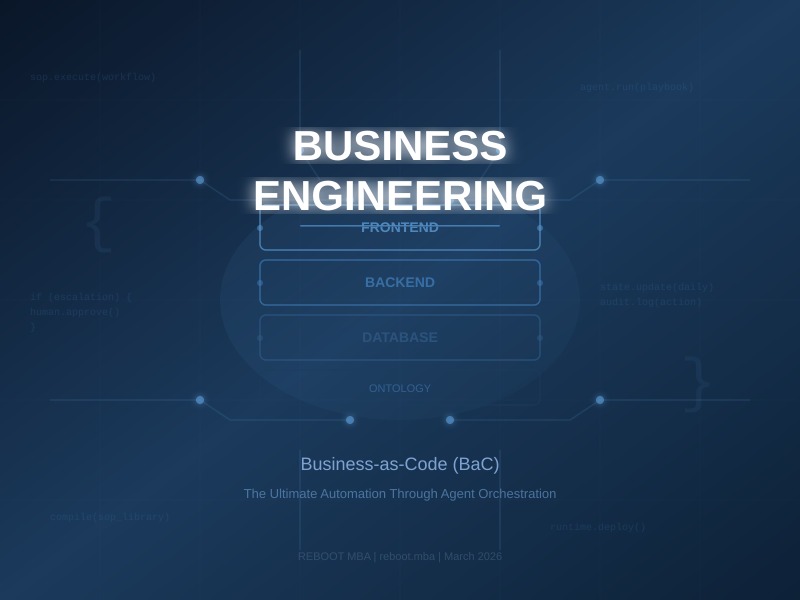
Business Engineering: Business-as-Code (BaC) — The Ultimate Automation Through Agent Orchestration
A research paper on the feasibility of AI-era Full-Stack Business Engineering. Every business is a codebase. SOPs are source code. AI agents are the runtime. This paper introduces Business Engineering as a formal discipline and Business-as-Code as its foundational methodology.

Can Due Diligence Be Computed? Capital Allocation After Knowledge Scarcity
As AI collapses the cost of evaluation and execution, the foundations of venture capital and institutional investing come under pressure. What remains scarce when judgment becomes computational?

From Profiling to Recommendations: The Shift From Attention to Memory in the Age of AI
As AI agents replace search and feeds with delegated decision-making, digital commerce shifts from profiling attention to owning memory. This transition rewrites incentives, concentrates power, and raises unresolved questions about trust, autonomy, and governance.