

The Myth of the Best People — And the Reality of Building Them
For decades, the executive mantra has been simple:
“Hire the best people.”
MBAs repeated it.
CEOs preached it.
Business books worshipped it.
Founders internalized it.
But this advice was never practical.
And in the age of AI, it is no longer even logical.
We now live in a world where:
- elite AI researchers cost $5–20M each
- Meta and OpenAI raid each other for talent
- startups cannot compete in these bidding wars
- remote work has dissolved organizational loyalty
- high performers optimize for impact, not employers
- the frontier is controlled by a tiny cluster of institutions
The “best people” were always a myth for most companies.
Now, even elite organizations struggle to access them.
It’s time to replace the myth with a better strategy:
stop searching for extraordinary people — build systems that create them.
1. The Zuckerberg Paradox — Proof the Old Model Is Collapsing
Meta reportedly spent over $100 million hiring away AI researchers from competitors.
This was not a hiring strategy.
It was an arms race.
The implications are brutal:
- Elite talent no longer responds to normal incentives
- AI expertise has become a geopolitical resource
- Compensation at the top is unbounded
- The talent frontier is consolidating into a few institutions
If Mark Zuckerberg must spend $20M to hire one exceptional researcher,
what chance does:
- a Series A startup have?
- a traditional company have?
- any SMB have?
The answer is obvious:
They don’t.
The “best people” model no longer scales.
2. Built to Last Never Anticipated This Talent Economy
Built to Last assumed:
- exceptional talent wants to join exceptional companies
- cultures attract elite performers
- the best people self-organize around vision
- values create long-term loyalty
But in reality:
- the elite are hunted, poached, and bid up
- loyalty is fragile
- vision competes with compensation
- values compete with opportunity
- stability competes with velocity
The modern talent economy is not cultural.
It is positional.
People do not join companies.
They join trajectories.
And if your company’s trajectory isn’t obvious,
no amount of “we hire the best people” messaging will compensate.
This is the modern Best People Trap:
You can’t attract elite people until you’ve already succeeded.
But you can’t succeed without elite people.
AI breaks this loop.
3. AI Collapses the Skill Gap but Widens the Judgment Gap
AI equalizes:
- implementation
- execution
- research
- analysis
- coding
- writing
This compresses the bottom end of talent:
- average → decent
- decent → good
- good → very good
But the frontier — the top 1% — moves further away:
- judgment
- architecture
- systems thinking
- abstraction
- interdisciplinary reasoning
- prioritization
- strategic narrative
AI magnifies these higher-order skills rather than replacing them.
This means:
The best people become even more valuable —
but they become even more inaccessible.
So chasing them is the wrong strategy.
4. The Country No Longer Needs More “Rockstars” — It Needs Better Systems
The majority of companies do not fail from lack of brilliance.
They fail from lack of:
- structure
- clarity
- rhythm
- alignment
- knowledge transfer
- memory
- decision hygiene
- process scalability
This is where AI quietly becomes the great equalizer.
AI can:
- embed institutional memory
- standardize execution
- accelerate learning
- bridge domain gaps
- guide decisions
- support onboarding
- create compounding systems
- elevate average performers into top performers
Remove constraints, and hidden potential surfaces.
The old model assumed:
“Only exceptional individuals can produce exceptional results.”
The new model is:
“Exceptional systems produce exceptional results from ordinary individuals.”
This is the future.
5. Why Most Companies Must Build Elite People, Not Hire Them
The myth of the “best people” collapses in the face of four truths:
Truth 1 — Elite people cluster at elite institutions
OpenAI, DeepMind, Meta, xAI, and similar hubs.
Truth 2 — Elite people follow elite trajectories
Not visions.
Not cultures.
Not slogans.
Truth 3 — Elite people are not loyal
They follow the frontier.
Truth 4 — You cannot recruit what you cannot afford
Not financially, not reputationally, not contextually.
This means:
Most organizations must construct their own elite talent.
Not hire it.
Not hope for it.
Not poach it.
Create it.
6. How to Manufacture Excellence (The AI-Age Playbook)
There are only three ways to reliably create top-tier talent internally:
1. Systems That Compound Judgment
Decision frameworks, context engines, postmortems, AI copilots.
2. Knowledge Infrastructure
Playbooks, SOPs, domain memory, agentic guidance.
3. Problem-Shaping Cultures
Not task-taking cultures.
Not “follow the spec” cultures.
Companies that win in the AI era:
- teach people to think
- give them tools to accelerate
- give them context to align
- give them space to explore
- reduce friction to build
When constraints disappear, people transform.
7. The Reboot
The original philosophy said:
“Build a great company by recruiting great people.”
The AI-era philosophy is the inverse:
“Build great people by constructing a great company.”
And then greatness compounds.
It’s not the individual that drives the system.
It’s the system that elevates the individual.
That is the secret the old business books never understood —
and the truth AI finally makes possible.
Recommended Readings in the Talent Series
Read more
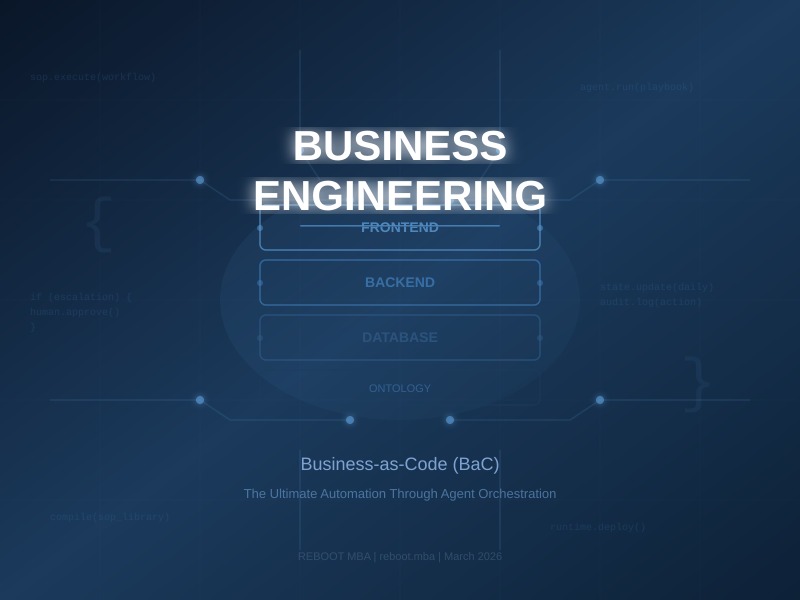
Business Engineering: Business-as-Code (BaC) — The Ultimate Automation Through Agent Orchestration
A research paper on the feasibility of AI-era Full-Stack Business Engineering. Every business is a codebase. SOPs are source code. AI agents are the runtime. This paper introduces Business Engineering as a formal discipline and Business-as-Code as its foundational methodology.

Can Due Diligence Be Computed? Capital Allocation After Knowledge Scarcity
As AI collapses the cost of evaluation and execution, the foundations of venture capital and institutional investing come under pressure. What remains scarce when judgment becomes computational?

From Profiling to Recommendations: The Shift From Attention to Memory in the Age of AI
As AI agents replace search and feeds with delegated decision-making, digital commerce shifts from profiling attention to owning memory. This transition rewrites incentives, concentrates power, and raises unresolved questions about trust, autonomy, and governance.